

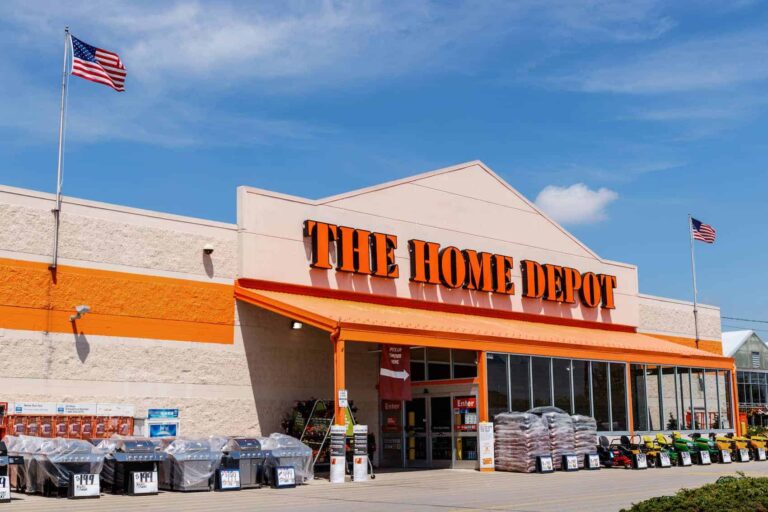

About 26 million Americans move each year, so it makes sense that a lot of people end up asking the same thing: Is it cheaper to rent a truck from Home Depot or from U-Haul? The quick answer is that U-Haul usually wins for short moves with low mileage, and Home Depot can come out ahead when you expect to drive a lot in one day.
For this comparison, we did what most people do. We booked the trucks, used them for the same simple local move, and paid the real prices. Plus, HireAHelper works with moving crews across the country and sees what rental trucks actually cost people every week. That gives us a solid base of experience to explain how these two brands compare. If you want more details on U-Haul’s lineup, you can check out our U-Haul truck review.
At a Glance: U-Haul vs. Home Depot Truck Rentals
Before we go deeper into pricing and truck features, here is a quick side-by-side look at how the two brands compare. The biggest difference is simple: Home Depot only offers one true moving truck, while U-Haul has 4 sizes that cover everything from a studio to a four-bedroom home. That alone shapes who each brand works best for.
| Category | Home Depot 12 ft Box Truck | U Haul (10 ft, 15 ft, 20 ft, 26 ft) |
| Truck Sizes | 1 moving truck size (12 ft, 515 cu ft) | 4 moving truck sizes (402 to 1,682 cu ft) |
| Best For | Studio or small 1-bedroom, short local hauling | Studio to 4 bedroom homes, small to large local or long distance |
| Pricing Structure | Time-based (75 min, hourly, day rate) | Daily base rate plus mileage |
| Mileage Charges | Unlimited miles included | About $1.19 per mile, varies by location |
| Daily Price | $149 per day | $19.95 to $49.95 per day |
| Coverage | No liability coverage offered | Multiple coverage options |
| One Way Rentals | No | Yes |
| Ramp | Ramp included | Ramp included on 15 ft, 20 ft, 26 ft |
| Dolly | Dolly included | Dolly rented separately |
| Return Rules | Must return to the same store | Return to the same or a different location, depending on rental type |
| Overall Value | Better for short, time-sensitive, high-mileage local moves | Better for most moves, especially longer or one-way trips |
Truck Sizes: Home Depot vs. U-Haul Truck Rental
Home Depot offers only one true moving truck size, while U-Haul has four. That difference alone shapes most of the pros and cons for each brand.
If you only need a single small truck for a quick local move, both brands can work. But if you need more space or want to finish your move in one trip, U-Haul is the only option that offers enough room. Since we are only looking at Home Depot-branded trucks (not Penske, which is also offered at Home Depot stores), here is a clear look at how each company compares on size options:
| Truck Type | Home Depot | U-Haul |
| Flatbed/Pickup Trucks (small items or store purchases) | ✅ | ✅ |
| Cargo Van Moving Truck (small furniture and boxes) | ✅ | ✅ |
| 12 ft box truck (studio or small 1 bedroom) | ✅ | ✅ 10 ft box truck |
| 15’ Moving Truck (1 bedroom home or 2 bedroom apartment) | ❌ | ✅ |
| 20’ Moving Truck (2 to 3 bedroom home) | ❌ | ✅ |
| 26’ Moving Truck (3 to 4 bedroom home) | ❌ | ✅ |
Home Depot Truck Sizes
Flatbeds and Pickups
These include the 8 ft pickup and two flatbed sizes (8 ft and 10 ft). They work best for store runs, materials, or oversized items that are fine staying uncovered.
- 8 ft pickup: carries up to 2,200 to 3,000 lbs and is good for small purchases
- 8 ft flatbed: open bed, sides that fold, about 77 cu ft of space
- 10 ft flatbed: larger open bed with 121 cu ft of space, also has folding sides.
These vehicles are helpful for projects but are not designed for moving furniture or boxed household items.
Cargo Van
This van has a low entry height and an enclosed space large enough for small furniture and boxes. It can work for a studio or a very small one-bedroom apartment.
- About 142.9 cu ft of usable cargo space
- Interior depth around 126 inches, width about 70 inches, height around 4 feet
- Max load about 3,000 lbs
The cargo van is a practical option for small apartment moves where you do not need a full box truck.
12 ft Box Truck
This is Home Depot’s only true moving truck and the one most people use when relocating household items.
- 515 cu ft of enclosed cargo space
- Fits a studio or a small one-bedroom
- Max load about 3,850 lbs
- Comes with a loading ramp, rear view camera, tie rails, and a dolly
- Unlimited mileage included
This truck has enough height and room for furniture, mattresses, and stacked boxes, but larger homes will require multiple trips.
U-Haul Truck Sizes
U-Haul has a wider range of moving vehicles than Home Depot, including a pickup, a cargo van, and four box truck sizes. The box trucks are the most useful for moving a home, since they offer the enclosed space and height needed for furniture and stacked boxes.
Pickup Truck
U-Haul’s 8 ft pickup is best for small jobs or hauling a few larger items. It also has real towing capacity, which can help with personal vehicles or equipment.
- Inside bed: 8 ft long by 5 ft 1 in wide, 1 ft 10.5 in tall
- Max load: 2,280 lbs
- Towing capacity: up to 6,000 lbs
- Seats 3 adults
This pickup is not ideal for moving a home, but it can help with small loads or towing something during your move.
Cargo Van
U-Haul’s 9 ft cargo van works for furniture, boxes, and small apartment moves, where you want a fully enclosed space.
- Enclosed cargo area, similar in size to Home Depot’s van
- Good for a studio or a small one-bedroom apartment
This van is a reasonable option if you do not need the height or ramp of a box truck.
10 ft Box Truck
This is U-Haul’s smallest box truck and a common pick for studio moves.
- 402 cu ft of cargo space
- Best for a studio or a small 1-bedroom apartment
- No loading ramp
This size is close to Home Depot’s 12 ft truck, but slightly smaller. It’s good for studio moves, or if you need to move a few big furniture items.
15 ft Box Truck
This is the step up for slightly larger households or those who have a lot of belongings in their studio or storage.
- 764 cu ft of cargo space
- Best for a 1-bedroom home or a 2-bedroom apartment
- Comes with a loading ramp
Works well when you want a single trip and have more furniture than a studio.
20 ft Box Truck
A good match for medium-sized moves, and one of the most common sizes for moving trucks.
- 1,016 cu ft of cargo space
- Best for a 2 to 3-bedroom home
- Loading ramp included
This is a strong all-around option for most family-sized moves.
26 ft Box Truck
U-Haul’s largest rental truck and the one that fits the most in one trip.
- 1,682 cu ft of cargo space
- Best for a 3 to 4 bedroom home
- Loading ramp included
This is the choice for bigger households or anyone who wants to avoid repeat trips.If you have a very large home, or a home with storage space like an attic and garage, this is probably the truck to pick
Pricing: Home Depot vs. U-Haul Truck Rentals
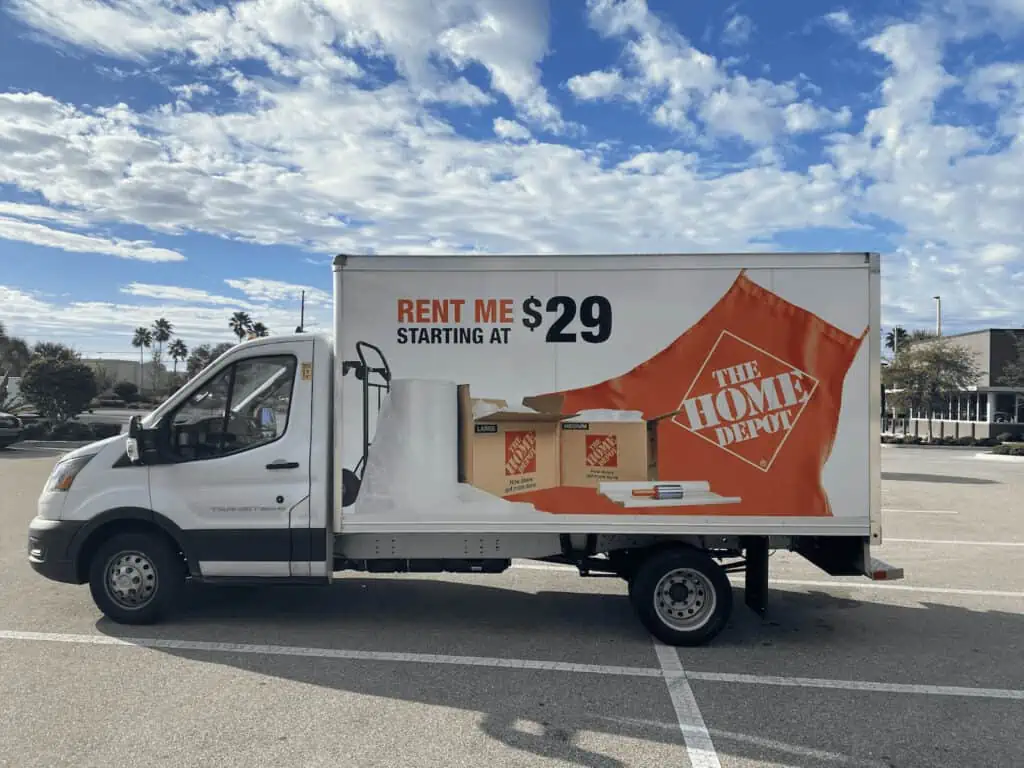
Home Depot is often cheaper for longer local moves because mileage is unlimited, while U-Haul is usually the better value for quick, low-mileage trips.
Home Depot keeps its pricing simple. You pay $29 for the first 75 minutes or $149 for a full day, with unlimited miles included. Optional damage protection is 15% of the rental price, and an environmental fee may be added at checkout. There is no hourly rate listed beyond the initial 75-minute window.
U-Haul uses a different model. All local rentals include a daily rate plus a per-mile charge. Mileage prices change based on your location and date, so the numbers you see online are just a starting point.
For example, in Phoenix, where we pulled our sample quotes, the pickup and cargo van were listed at $19.95 per day plus $1.09 per mile. The box trucks ranged from $19.95 to $49.95 per day, plus $1.29 per mile. Additional small fees apply, and renters can add damage protection or equipment like dollies if needed.
To make the comparison easy, here is a look at what both companies would charge for a six-hour, 30-mile local move before taxes and optional add-ons.
Important U-Haul Mileage Rates Change a Lot by City: U-Haul mileage rates are not the same everywhere. On the same date, Phoenix listed $1.29 per mile for box trucks, Tampa listed $1.39 per mile, and New York City listed up to $2.49 per mile. That difference can double your final cost on a longer local move, so it’s worth checking your local mileage rate before you book.
Cost Example: 6 Hour, 30 Mile Local Move
| Truck | Estimated Cost Before Taxes | How It’s Calculated |
| Home Depot Cargo Van | $149 | Full day rate, unlimited miles. Does not include optional damage protection or environmental fees. |
| Home Depot 12 ft Box Truck | $149 | Full day rate, unlimited miles. Does not include optional damage protection or environmental fees. |
| U-Haul Pickup (8 ft) | $52.65 | $19.95 day rate plus 30 miles at $1.09 per mile, plus standard local fees. Does not include optional coverage or dolly. |
| U-Haul Cargo Van (9 ft) | $52.65 | $19.95 day rate plus 30 miles at $1.09 per mile, plus standard local fees. Does not include optional coverage or dolly. |
| U-Haul 10 ft Truck | $58.65 | $19.95 day rate plus 30 miles at $1.29 per mile, plus standard local fees. Does not include optional coverage or dolly. |
| U-Haul 15 ft Truck | $68.65 | $29.95 day rate plus 30 miles at $1.29 per mile, plus standard local fees. Does not include optional coverage or dolly. |
| U-Haul 20 ft Truck | $78.65 | $39.95 day rate plus 30 miles at $1.29 per mile, plus standard local fees. Does not include optional coverage or dolly. |
| U-Haul 26 ft Truck | $88.65 | $49.95 day rate plus 30 miles at $1.29 per mile, plus standard local fees. Does not include optional coverage or dolly. |
What This Example Shows
For short local trips, U-Haul usually comes out ahead because the mileage fees stay low and the base rates are inexpensive. Once your mileage climbs, Home Depot becomes more cost-effective because the price does not increase with distance.
However, if you need the room to move a larger home, U-Haul is the only brand with truck sizes big enough to finish in one trip. Home Depot works best for small homes or simple hauls where unlimited miles save the most money.
Home Depot Truck Rental Pricing
Home Depot’s pricing is time-based, with a $29 rate for the first 75 minutes and a flat $149 daily rate, plus an option to rent by the week. Exact pricing is determined at the store, but the advertised pricing online is as follows:
- $149.00 per day (regardless of number of hours)
- $1,043.00 per week
Your rental may be subject to additional fees, such as:
- Environmental fee (may apply)
- Damage protection (15% of the cost of your rental) — Optional
After all that, you still have to cover tax and gas, but at least there are no mileage fees!
U-Haul Truck Rental Pricing
U-Haul uses a mileage-based pricing model. You pay a daily rate based on the truck size plus a per-mile charge, which can make short local moves very affordable. For a deeper look at how these costs add up, you can read our full breakdown in How Much Does a U-Haul Really Cost?
Long-distance and one-way rentals follow a flat rate structure with additional fees, but most local renters will pay the daily rate, mileage, and any optional coverage they choose. Mileage rates vary by location. In Phoenix, box trucks currently run $1.29 per mile, while pickups and vans run $1.09 per mile.
U-Haul Local Truck Pricing (Phoenix Example)
| Truck Size | Base Daily Rate | Additional Mileage Fee* |
| 10-Foot Truck | $19.95 | $1.29 per mile |
| 15-Foot Truck | $29.95 | $1.29 per mile |
| 20-Foot Truck | $39.95 | $1.29 per mile |
| 26-Foot Truck | $49.95 | $1.29 per mile |
Mileage fees may change based on demand, season, and pickup location. U-Haul also adds standard small fees, including a vehicle license recovery fee, an environmental fee, and optional damage protection. These charges can bring your final price up before tax and fuel.
Which Moving Truck Rental Is Cheaper?
U-Haul is usually cheaper for short, low-mileage moves, while Home Depot becomes the better value once your trip gets longer. That difference comes down to how each brand sets prices.
Home Depot charges a flat $29 for the first 75 minutes or $149 for a full day, and mileage is unlimited. You do not pay more for driving farther.
U-Haul’s daily rates seem low, but the price goes up with every mile. In many cities, the mileage fee is more than a dollar per mile, which adds up quickly once you pass local, in-town distances.
The result is simple:
- If your move is close by, U-Haul usually wins.
- If your move covers more ground, Home Depot often ends up cheaper.
Price Breakpoint: When Does Home Depot Become Cheaper?
Home Depot becomes cheaper when your mileage climbs high enough that U-Haul’s per-mile charges push the final cost above the $149 daily rate. Since Home Depot’s price does not change once you hit the day rate, the gap can widen quickly. U-Haul stays ahead for small, close moves. Once you hit a moderate distance, the math flips.
Line Graph Placeholder: Price vs Mileage for Home Depot 12 ft Truck vs U-Haul Truck Sizes
The graph above shows how U-Haul’s price climbs mile by mile, while Home Depot stays flat. Each U-Haul truck reaches that $149 point at a different distance, but most hit it sooner than people expect.
Real World Use Cases
Below are examples using current pricing out of Phoenix, AZ. Mileage fees, base rates, and small add-on charges can shift by region, so think of these as helpful benchmarks rather than exact totals for your area. Each scenario shows how the cost changes when time or mileage increases.
Cost Example: 1-Hour 15-Minute Move / 8 Miles
This distance is an example of moving to the next neighborhood over, maybe just a few blocks from your old place.
Winner: Home Depot
| Truck | Estimated Total Before Taxes and Fees | How It Is Calculated |
| Home Depot 12 ft | $29.00 | $29 for the first 75 minutes, unlimited miles |
| U-Haul 15 ft | $29.95 + ($1.29 × 8 miles) = $40.27 | Daily rate plus mileage |
For short moves with a handful of miles, Home Depot’s 75-minute rate is hard to beat. But what about higher-mileage and more time-intensive moves?
Cost Example: 4-Hour 15-Minute Move / 22 Miles
Picture a typical across-town move here, the kind where you make two short trips to get everything settled.
Winner: U-Haul
| Truck | Estimated Total Before Taxes and Fees | How It Is Calculated |
| Home Depot 12 ft | $149.00 | Full day rate, unlimited miles |
| U-Haul 15 ft | $29.95 + ($1.29 × 22 miles) = $58.33 | Daily rate plus mileage |
When your move goes past the 75-minute mark but is still within a small radius, U-Haul usually costs much less. Keep in mind that Home Depot doesn’t offer one-way moves. You have to return the truck to the same location where it was rented.
Cost Example: 1 Day Move / 120 Miles
This reflects a full-day move where you’re driving between nearby cities and getting everything loaded and unloaded in one stretch.
Winner: Home Depot
| Truck | Estimated Total Before Taxes and Fees | How It Is Calculated |
| Home Depot 12 ft | $149.00 | Flat daily rate, unlimited miles |
| U-Haul 15 ft | $29.95 + ($1.29 × 120 miles) = $184.75 | Daily rate plus mileage |
Once mileage climbs, Home Depot’s flat daily rate pulls ahead quickly. At 120 miles, the savings become significant.
Availability: Home Depot vs. U-Haul
U-Haul has far more availability, offers more pickup and drop-off flexibility, and has a larger fleet. Home Depot works well if you live near a store that has trucks in stock, but its single moving truck size and same location return rules limit how widely you can use it.
Home Depot Availability
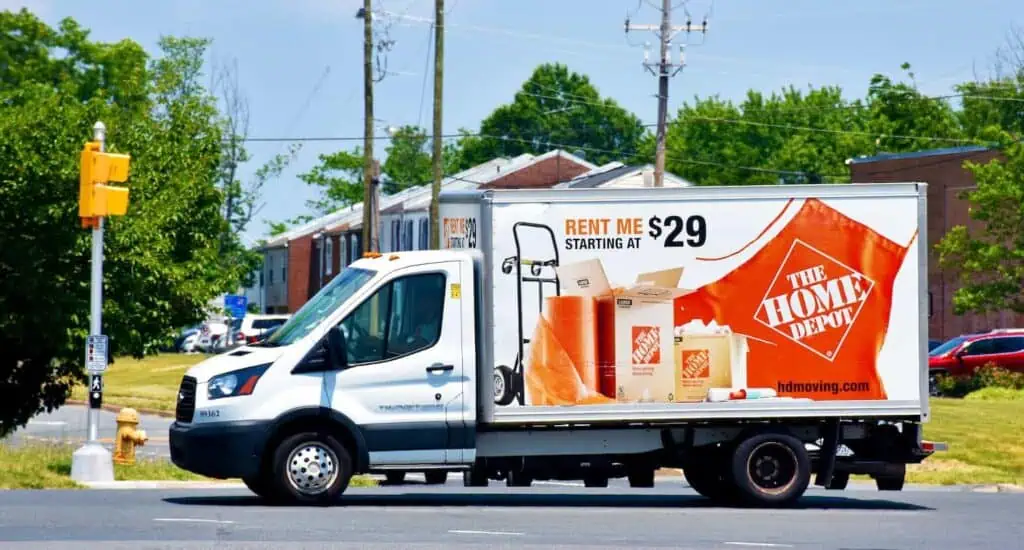
Home Depot has more than 2,000 stores in the United States, but only some locations carry branded moving trucks. Availability can vary a lot by store and by region, and truck inventory is not guaranteed. Since Home Depot only offers one true moving truck size, you may not have the option to scale up if you need more space.
Hours of operation for truck rental generally follow store hours. Many locations open early, which can help with early morning moves, but you must return your rental to the same store where you picked it up. No one-way rentals are available for Home Depot-branded trucks.
Home Depot is a good fit when you live close to a store that has trucks in stock, and you only need a small moving truck for a short local job.
U-Haul Availability
U-Haul has more than 21,000 rental locations nationwide, including stores, neighborhood dealers, and partner sites. This network is far larger than Home Depot’s, which makes it easier to find a truck nearby. It also means you have a higher chance of finding the exact truck size you want.
PULL QUOTE: “Each truck is rented out with a full tank of gas, and you’re expected to top it off before returning it. If you don’t, Home Depot may automatically charge a refueling fee, which is typically higher than the average price at a gas station.”
Hours vary by location, but U-Haul also offers 24/7 pickup and drop off through its mobile app at many sites. This makes it easier to schedule moves outside of standard business hours. U-Haul also supports one-way rentals, which is important for anyone moving between cities.
With more truck sizes, more locations, and more pickup and drop-off flexibility, U-Haul is usually the easier option for most people, especially if you need a larger truck or do not live near a Home Depot with moving trucks in stock.
Fuel Efficiency: Home Depot vs. U-Haul Truck Rentals
Home Depot’s trucks tend to get slightly better gas mileage because they are newer, but real-world MPG varies depending on load, driving speed, and the specific truck you receive.
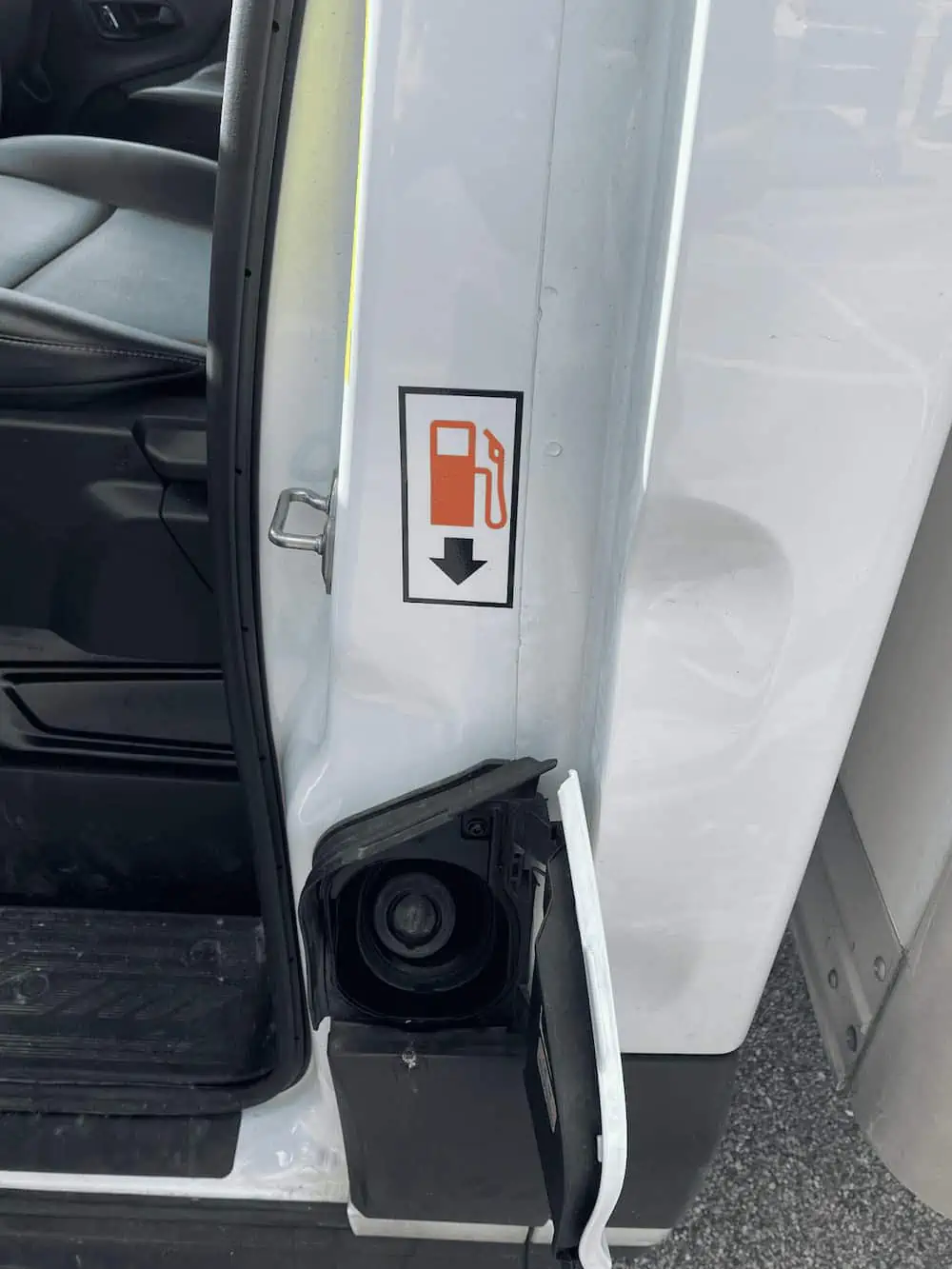
With Home Depot, vehicle make, model, and year may vary by location, which means that not all Home Depot box trucks are created equal. But since U-Hauls aren’t exactly jaw-droppingly efficient, chances are the fuel efficiency of a Home Depot truck will be better than a U-Haul. This is because, as Home Depot trucks are a newer thing, the trucks themselves are likely to be fairly new.
The truck we rented was a new Ford Transit 350 HD, and it was quite fuel-efficient. It even had a little MPG indicator on the dash that tells you how you’re doing. Ours got 12 miles to the gallon. We drove 8 miles and only spent $1.39 to top it off when we were done.
U-Haul Rental Truck Fuel Efficiency
U-Haul’s 10-foot rental truck gets up to 12 miles to the gallon under ideal driving circumstances. Once you’ve loaded the truck with all your belongings, expect that number to drop. MPG estimates for the larger trucks cap out at 10 miles per gallon, under ideal circumstances.
Ease of Driving: Home Depot vs. U-Haul Truck Rentals
Home Depot’s smaller, newer trucks are often easier and more comfortable to drive, while U-Haul’s driving experience depends more on the age and condition of the specific truck you are given.
Driving a Home Depot Rental Truck
Home Depot’s box truck is smaller than most U-Haul trucks, plus the fleet is relatively newer. As a result, driving a Home Depot truck might be more comfortable and feel more like driving a pick-up truck than a boxy moving truck. The cab is lower and easier to get into, parking is less of an issue, and the wide mirrors mean visibility is generally good.
Driving a U-Haul Rental Truck
U-Haul’s fleet has been around longer, and some rentals simply aren’t as new as others. The 10-foot trucks should be relatively easy to drive (like Home Depot’s 12-foot rental), but the larger models can be more challenging to maneuver and ride a little rougher.
Coverage Options: Home Depot vs. U-Haul Truck Rentals
Home Depot offers very limited coverage, while U-Haul provides several protection plans that cover more situations and give renters more peace of mind.
Home Depot Coverage Options
Home Depot only offers a damage protection plan for 15% of the cost of a rental. It covers up to $500 of repair costs for non-collision physical damage and also covers replacement charges of non-collision damage (not including theft). However, the coverage doesn’t include damage protection for your cargo, personal liability, or injury protection.
Instead, they take your insurance information, and your own car insurance provider is placed on the hook. So definitely be sure to take pictures of your truck before and after the rental!
U-Haul Coverage Options
U-Haul has several coverage options at various price points, from simple roadside assistance to supplemental liability coverage, cargo protection, and more. Between Home Depot and U-Haul, U-Haul definitely has more and better coverage options.
Reservation Process: Home Depot vs. U-Haul Truck Rentals
U-Haul’s reservation system is easier and more flexible, while Home Depot requires an account, a higher deposit, and offers fewer pickup and return options.
Reserving a Home Depot Rental Truck
Home Depot allows you to search for stores with available trucks in your area — which is convenient — but then you have to sign in or create an account and pay a deposit to reserve a truck. Reservations are done through the same system used to reserve tool rentals, so the wording can seem a bit funny at times.
PULL QUOTE: “Home Depot keeps its pricing simple. You pay $29 for the first 75 minutes or $149 for a full day, with unlimited miles included.”
A two-hour rental reservation required a $150 deposit or credit card hold, which is almost triple the rental price. Of course, it’s just a deposit and will be refunded when the truck is returned as long as everything is in order.
Reserving a U-Haul Rental Truck
U-Haul’s online reservation system is streamlined and easy to use. After specifying when and where you want to rent a truck, you compare rates, select pickup and drop-off locations, choose coverage, and any other add-ons you might need. The only downside might be all the “upsell” pages that you have to click through to get to your quote. But if you need the add-ons, then it’s actually super helpful.
Returning the Truck: Home Depot vs. U-Haul Truck Rentals
Home Depot requires same-location returns and proof of refueling, while U-Haul offers more flexible return options but still expects the truck to be refueled and cleaned.
Returning a Home Depot Rental Truck
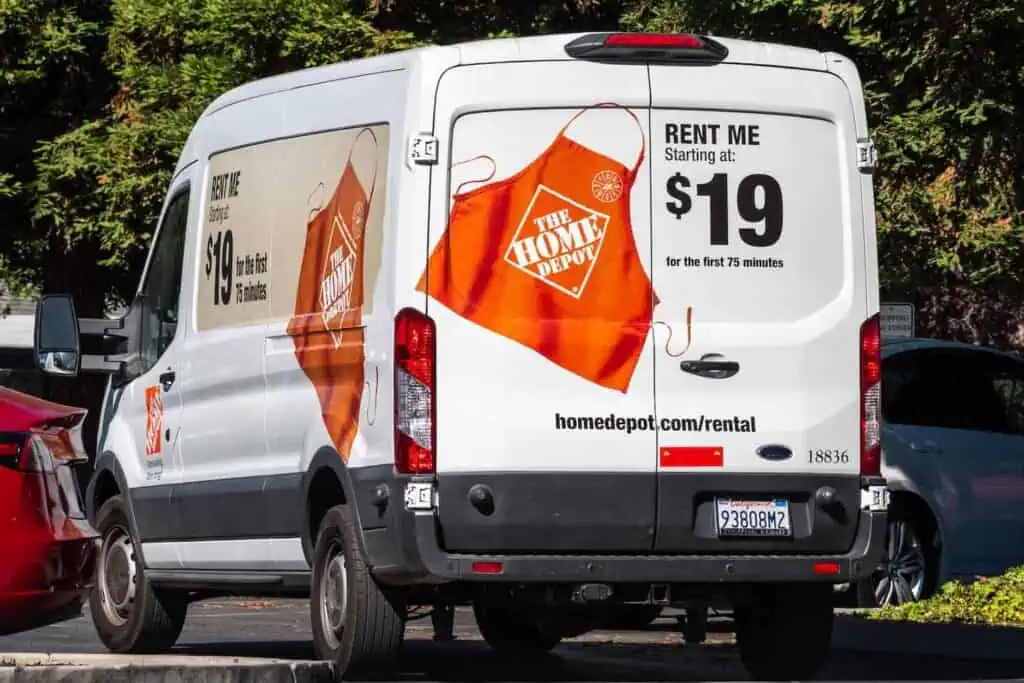
Home Depot trucks must be returned to the same location they were picked up. Each truck is rented out with a full tank of gas, and you’re expected to top it off before returning it. If you don’t, Home Depot may automatically charge a refueling fee, which is typically higher than the average price at a gas station. So be sure to top it off, snap a pic, and keep your gas receipt! The Tool Rental associate will ask to see the receipt, which covers you for any fuel used on the way back from the gas station to Home Depot.
Returning a U-Haul Rental Truck
When you pick up your U-Haul truck, your paperwork should indicate the current fuel level, but it’s always a good idea to double-check before taking off. You’re responsible for returning the truck with the same amount of fuel as when you picked it up. Otherwise (you guessed it) you’ll be charged a fuel replacement fee. Remember to remove any garbage and give the truck a quick sweep, or you may be charged a cleaning fee as well.
Pros and Cons: Home Depot vs. U-Haul Truck Rentals
So, with all this in mind, how does Home Depot stack up against U-Haul when it comes to moving truck rentals?
Pros and Cons: Home Depot Truck Rentals
| Pros | Cons |
|
|
Pros and Cons: U-Haul Truck Rentals
| Pros | Cons |
|
|
Home Depot keeps pricing simple with unlimited miles and a single 12-foot moving truck. This can save money on longer local days, but the fleet is limited, and the lack of liability coverage means your own auto insurance must apply.
U-Haul offers more truck sizes, one-way rentals, and stronger protection plans. The tradeoff is the mileage fee, which can get expensive in some cities. For short trips, U-Haul is usually cheaper. For longer local days, Home Depot often catches up.
Home Depot stores also tend to open early, which can be helpful for timing your move, while U-Haul’s 24/7 mobile pickup offers more flexible start times.
Which Is Better? Home Depot vs. U-Haul Truck Rentals
We’ve said this before, and we’ll say it again: U-Haul wins the short-distance race against virtually all of its competitors. So, if you need a truck for a quick in-town move, U-Haul’s pricing is really hard to beat — unless you can load, drive, and unload a small apartment and drop off your truck in under 75 minutes.
But if you’re only moving a few pieces of large furniture and that’s it, or if you have lots of miles to drive and don’t mind dropping off the truck where you picked it up, then Home Depot becomes a very nice alternative.
Scorecard summary
Below is a quick look at how Home Depot and U-Haul performed across each category.
| Category | Winner | Why |
| Price for short local moves | U-Haul | Lower daily rates and low mileage make quick, in-town trips cheaper. |
| Price for longer local days | Home Depot | Flat daily rate with unlimited miles beats U-Haul once mileage climbs. |
| Truck size selection | U-Haul | Four box truck sizes, plus pickup and cargo vans, allows one-trip moves. |
| One-way rentals | U-Haul | Home Depot offers none on branded trucks. U-Haul supports regional and cross-country trips. |
| Ease of driving | Home Depot | Newer trucks and smaller size make them simpler to park and handle. |
| Availability | U-Haul | More locations, more inventory, and 24/7 mobile pickup options. |
| Coverage options | U-Haul | Multiple protection plans vs. Home Depot’s minimal coverage. |
| Fuel cost predictability | Home Depot | Newer trucks often get slightly better actual MPG. |
| Best for beginners | Home Depot | Small, easy to drive, and straightforward pricing. |
Making the Most of Your Moving Truck Rental
Hiring professional movers on an hourly basis can make a huge difference when using a time-sensitive moving solution. Since Home Depot is all about the hourly rate, having movers expedite the move can shave some time off that final bill. But not only that, they can use their Tetris skills to pack the truck way more efficiently than most of us ever could. This means secure belongings that don’t shift in transit (aka less damage) and fewer trips back and forth.
If you are not sure how much help you really need, you can start with our guide on how many movers you should hire. Once you have a sense of the right crew size, HireAHelper makes it easy to compare local moving pros, see real customer reviews, and book the help that fits your timeline and budget.
Why Trust HireAHelper
This guide is built on real data and real testing. We gathered current prices straight from each company, checked truck availability across multiple cities, and ran the same move scenarios using the published rates. Every cost example reflects the numbers renters actually see, not rough guesses.
HireAHelper has helped millions of people move since 2007, and we spend a lot of time studying how truck rentals work in the real world. Because we track pricing trends and hear from customers every day, we have a clear view of what each brand does well and where the trade-offs are. Our goal is to give you reliable information so you can choose the truck that fits your move with confidence.