

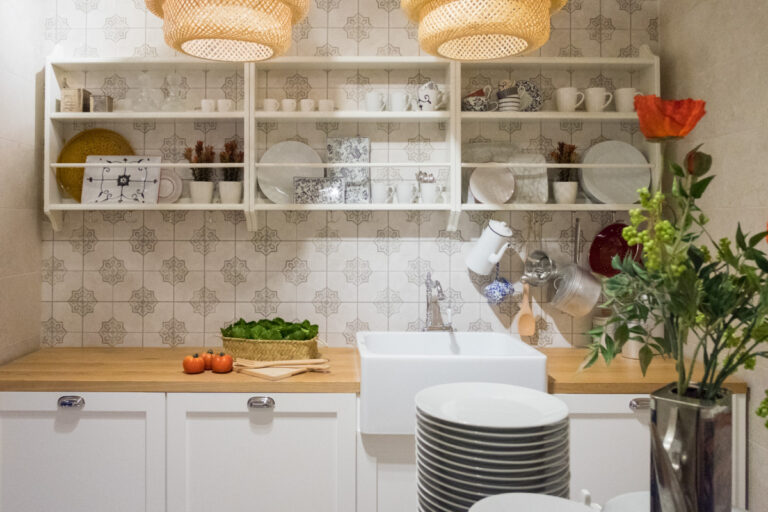

Subway tile had a long run. It felt safe, clean, and easy to pair with anything. But in 2026, kitchens are moving away from predictable brick layouts and flat white surfaces. Designers and homeowners are choosing backsplashes with texture, pattern, scale, and stronger material presence.

From full marble slabs and tonal hex gradients to terracotta walls and sculpted relief tiles, today’s backsplashes do more than protect drywall. They anchor the cooking zone, frame the range, and shift the entire mood of the kitchen. If you are ready to move beyond standard white rectangles, these ideas show what is replacing subway tile now.
1. Terracotta Pattern Revival

This warm terracotta backsplash replaces plain white tile with texture and rhythm. The small geometric pattern adds movement without overpowering the wood shelves and brass faucet. It feels layered and collected rather than builder basic.
Paired with open shelving and natural grain countertops, the tile brings depth that subway layouts rarely achieve. This is pattern used with restraint, where warmth becomes the statement instead of repetition.
2. Soft Square Texture Grid

These handmade square tiles break away from the predictable horizontal subway line. The subtle tonal variation creates texture across the surface, making the backsplash feel crafted rather than installed.
Against shaker cabinets and marble counters, the imperfect edges add character. It proves that even neutral kitchens can feel rich when the tile has dimension.
3. Vertical Blue Statement Wall

Vertical stacked blue tiles turn the backsplash into a bold frame around the window. The long lines draw the eye upward and change the entire proportion of the space.
Paired with wood cabinetry and dark counters, the deep tone feels grounded and modern. This layout avoids the visual stop-start rhythm of subway and creates a strong architectural backdrop.
4. Star Tile Warm Geometry

This patterned tile replaces linear layouts with interlocking shapes that feel custom and intentional. The soft peach and sand tones add warmth without overwhelming the cabinetry.
Instead of blending into the background, the backsplash becomes part of the design story. It feels crafted, thoughtful, and far more memorable than a standard brick pattern.
5. Blush Vertical Stack

Glossy blush tiles stacked in clean vertical lines offer movement without clutter. The narrow format creates height and gives the wall a tailored feel.
Combined with brass hardware and darker lower cabinets, the color brings softness that subway tile cannot deliver. It feels expressive yet controlled, a quiet shift away from safe white.
6. Organic Marble Web Slab

This backsplash replaces tile repetition with a single dramatic marble slab. The branching veining spreads across the wall like a network, turning the cooking zone into a focal plane rather than background surface.
Paired with cream cabinetry and brass details, the slab feels elevated without excess pattern. It removes grout lines and visual noise, letting the material carry the design weight.
7. Micro Mosaic Texture Field

Tiny square mosaic tiles create a dense surface that reads as texture from a distance. Instead of large shapes, this backsplash builds rhythm through repetition and tonal variation.
Against gray cabinetry and a farmhouse sink, the small scale adds refinement. It softens the transition between counter and wall while keeping the look structured.
8. Soft Geometric White Pattern

This white geometric tile introduces pattern without strong contrast. The repeating petal motif adds movement while staying within a restrained palette.
With marble counters and minimal hardware, the backsplash provides depth that flat subway layouts cannot. It feels considered and architectural.
9. Glossy Herringbone Calm

Classic rectangular tiles gain energy when laid in a herringbone format. The diagonal direction breaks the predictable grid and adds motion across the wall.
The soft blue-gray glaze reflects light and keeps the space grounded. Layout alone transforms a basic tile into a statement surface.
10. Diamond Inlay Detail

This diamond grid includes subtle iridescent inserts that interrupt a standard pattern. The detail feels custom without overpowering cabinetry.
Set against white counters and wood accents, the shimmer adds dimension. It is a controlled way to elevate a neutral kitchen.
11. Textured Cross Relief Tile

Raised cross-shaped tiles add shadow and depth through form rather than color. The surface shifts under range lighting and creates subtle contrast.
Paired with warm wood cabinetry and a metal hood, the texture introduces structure without busy pattern.
12. Terracotta Hexagon Wall

Large matte terracotta hex tiles bring warmth and weight to the backsplash. The scale reduces grout distraction and keeps the pattern cohesive.
Combined with sage cabinetry and open shelving, the earthy tone replaces sterile white with grounded color.
13. Mixed Stone Patchwork

This backsplash layers varying stone sizes into a patchwork composition. The irregular layout disrupts symmetry and adds natural texture.
With dark counters and wood accents, the palette feels collected and layered rather than uniform.
14. Monochrome Hex Gradient

Hex tiles in shifting gray tones form a tonal gradient behind the range. The darker center anchors the cooktop while lighter shades fade outward.
Against dark cabinetry and brass fixtures, the wall reads graphic and intentional without bold color.
15. Sculpted Floral Relief Panel

Repeating floral relief tiles introduce depth within a neutral palette. The raised surface casts shadows that change throughout the day.
Framed by traditional cabinetry, the backsplash adds character without disrupting calm proportions.