

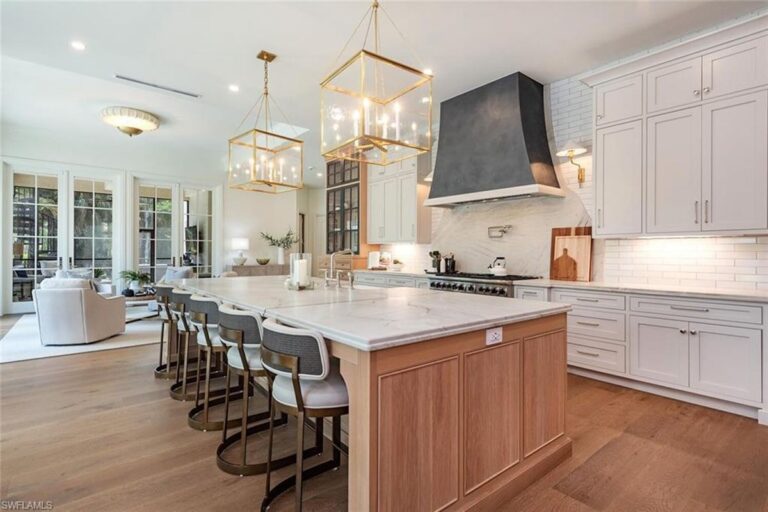

Luxury buyers are not paying more for dramatic kitchens. They are paying more for finished kitchens. After reviewing several active multi-million dollar listings in Naples with Matt Brown Real Estate Advisor, a consistent pattern emerged. The kitchens that generate stronger offers are resolved, proportioned correctly, and aligned with the architecture of the home.
- Not trendy.
- Not experimental.
- Not overdesigned.
From each property, Matt shared what buyers react to immediately — and what causes hesitation.
Here is what performs.
The Balanced Coastal Kitchen With Integrated Appliances

This kitchen works because the fundamentals are correct. Clean white cabinetry. Wide-plank white oak floors. A properly scaled quartz island that anchors the room without blocking movement. Integrated LG Signature appliances that sit flush within the cabinetry wall. Strong natural light from impact glass that reinforces the indoor-outdoor connection buyers expect in Olde Naples.
Matt has observed that buyers at this level focus on layout and finish quality, not decorative details. When the kitchen feels complete and requires no immediate upgrades, decision time shortens. In this case, there is no visible compromise in scale, materials, or flow. That clarity increases buyer confidence, and confidence drives stronger offers.
The Large-Scale Kitchen That Matches the Architecture

This kitchen succeeds for a different reason: scale. Dark wood cabinetry, natural stone counters, and a substantial island define the space. The island is oversized, designed for seating, prep, and serving without compromising circulation. Ceiling height and floor detailing reinforce volume. Appliances are high-end and built to support a household that entertains and hosts extended family.
Matt has observed that in communities like Collier’s Reserve, buyers respond to presence. They want the kitchen to match the square footage and ceiling height of the home. An underscaled or lightly finished kitchen would weaken a property of this size. Here, the cabinetry depth, island footprint, and material weight align with the architecture. That proportional consistency supports value because nothing feels downgraded relative to the rest of the house.
The Craftsmanship-Driven Estate Kitchen

This kitchen performs at a different tier. Rift-sawn white oak cabinetry, honed Mont Blanc quartzite, brass accents, and a full butler’s pantry signal investment without excess. The island is large but disciplined. The material palette is controlled: oak, white, black, brass. The Viking range and Sub-Zero refrigeration support the scale of the house without turning the room into a showroom.
Matt has seen that in estates of this size, buyers expect craftsmanship to match square footage. If the kitchen feels generic, the entire property weakens. Here, cabinetry detail, slab selection, and ceiling height align with the architecture. The space supports entertaining, private dining, and daily use without compromise. That alignment between build quality and house size protects value and supports premium positioning.
The High-Contrast Kitchen Built for Indoor-Outdoor Living

This kitchen balances warmth and structure. White perimeter cabinetry keeps the room light, while the darker island base grounds the space. The island is long enough to function as prep zone, seating area, and visual anchor without interrupting flow to the dining and living areas. Viking appliances, a gas cooktop, and a walk-in pantry support daily use without turning the kitchen into a statement piece. Wide-plank white oak floors tie it back to the architecture.
Matt has observed that buyers respond well to contrast that feels controlled. When the island and perimeter cabinetry work together instead of competing, the room reads intentional. In this home, the kitchen connects directly to outdoor living through large sliders, which reinforces how Naples buyers actually use the space. The layout supports entertaining, but it also works for daily life. That balance protects value.
The Functional Layout Held Back by Dated Finishes

The layout works. It opens to the living areas, has good counter space, and the island supports seating. Circulation is clean.
The issue is age. Raised-panel cabinetry, heavier granite, and older appliance integration place it in a previous renovation cycle. Matt has seen that in homes like this, buyers factor in immediate upgrade costs. The location protects value. The kitchen limits the premium.
The New-Construction Kitchen With Zero Renovation Risk

This kitchen performs because it feels current without excess. White cabinetry, a waterfall quartz island, and controlled contrast on the darker island base create clarity. The KitchenAid dual ovens, pot filler, and built-in bar are functional upgrades, not decorative additions. The scale matches the 13-foot ceilings, and circulation remains clean between prep, seating, and living areas.
Matt has noted that newer construction like this attracts buyers who want zero renovation risk. When cabinetry, lighting, appliances, and layout already align with current expectations, buyers focus on land and privacy instead of remodel budgets. In acreage properties, that confidence supports stronger positioning because the kitchen does not introduce uncertainty.
Concnlustion
Across price points and communities, the pattern remains consistent.
When scale matches architecture, materials feel current, appliances integrate cleanly, and circulation works without compromise, buyers move faster and negotiate less. When finishes feel dated or disproportionate, even prime locations struggle to command top-tier premiums.
Matt’s experience in the Naples market confirms what these properties demonstrate: the kitchen is not judged on decoration. It is judged on confidence.
In 2026, luxury buyers are not paying more for statement design. They are paying more for kitchens that eliminate doubt.