

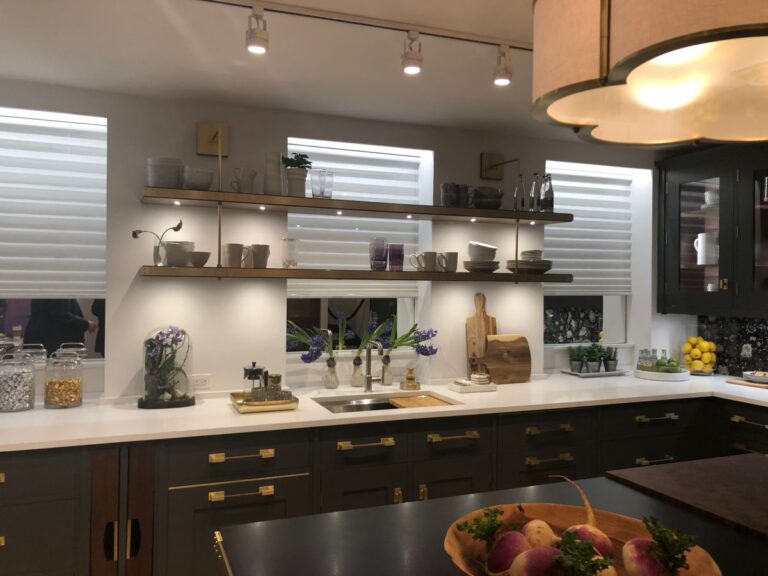

Upper cabinets used to define the kitchen. They filled every wall, maximized storage, and kept everything hidden. But in newer kitchens, that approach is starting to feel heavy and closed off.

After seeing more spaces move toward open systems, I started paying attention to how designers are replacing traditional upper cabinets with simpler, more flexible setups.
What stands out is how much lighter and more intentional these kitchens feel. The storage doesn’t disappear — it just shifts into forms that feel more integrated into the space.
These are the kitchen ideas where open systems are replacing upper cabinets in a way that actually works.
The Full Wall of Floating Shelves Replacing Upper Cabinets

Instead of breaking the wall with multiple cabinet boxes, this setup uses continuous floating shelves across the entire backsplash.
The result feels more architectural. The shelves create horizontal lines that guide the eye, while everyday items become part of the design instead of being hidden away.
The Mixed Storage Wall Combining Cabinets and Open Sections

Not every kitchen removes upper cabinets completely. This approach keeps some closed storage while opening up key areas.
By mixing shelves with cabinets, the wall feels lighter without sacrificing function. The open sections highlight frequently used items, while everything else stays tucked away.
The Minimal Corner Layout Removing Upper Storage Entirely

In smaller kitchens, removing upper cabinets completely can make the biggest difference.
This layout leaves the walls open and uses simple floating shelves only where needed. The space immediately feels wider, even though nothing structural has changed.
The Marble Backsplash Becoming the Main Feature

Without upper cabinets, the backsplash becomes a focal point.
Here, full-height stone takes over the wall, with minimal shelving layered in front. The absence of cabinets allows the material to stand out instead of being broken into sections.
The Compact Kitchen Using One Shelf Instead of Cabinets

Instead of filling the wall, a single shelf handles the essentials.
This works especially well in smaller or older kitchens where too many cabinets would feel overwhelming. The simplicity keeps the space functional without adding visual weight.
The Symmetrical Shelf Layout Creating Visual Balance

Open shelving can feel messy without structure. This layout solves that by keeping everything aligned.
Equal spacing, consistent materials, and balanced styling make the shelves feel intentional rather than improvised.
The Glass-Accent Cabinet Paired With Open Shelves

Instead of solid upper cabinets, glass-front storage pairs with open shelves.
This softens the visual impact while still offering enclosed storage. The combination keeps the wall from feeling too empty or too heavy.
The Shelf-and-Rail System Replacing Upper Storage

This setup adds hooks and rails beneath a shelf to increase function.
Mugs, utensils, and small tools hang below, freeing up shelf space while keeping everything accessible. It turns storage into something flexible and adaptable.
The Warm Wood Shelves Softening a Neutral Kitchen

Removing upper cabinets can make a kitchen feel too minimal. Wood shelves solve that.
They add warmth and texture while keeping the openness intact. The contrast between clean cabinetry and natural wood makes the space feel more balanced.
The Window Wall Left Open Instead of Covered

Upper cabinets often block natural light. This layout avoids that completely.
By leaving the wall open and limiting storage to shelves, the kitchen feels brighter and more connected to the outside.
The Vertical Shelf Stack Replacing Cabinet Columns

Instead of horizontal cabinets, vertical shelves create a different rhythm.
This approach works especially well in narrow spaces, where vertical storage feels more efficient and less bulky than stacked cabinet units.
The Compact Shelf System in a Small Modern Kitchen

Even in compact layouts, removing upper cabinets can work when storage is simplified.
A single continuous shelf keeps everything accessible without crowding the wall, making the kitchen feel more open than its actual size.