


Want a kitchen that feels open even when it’s packed with features? Glass countertops are starting to replace heavy surfaces that block light and break the flow between zones. In 2026, the shift is not about decoration. It is about visibility, reflection, and how surfaces interact with the rest of the room.

What stands out is how these counters change the structure of the space. Edges glow instead of disappear, islands feel lighter even when large, and transitions between cooking, dining, and living areas stay uninterrupted. Glass works as both surface and lighting tool, which gives designers more control without adding more elements.
From raised bar layers to full waterfall slabs and outdoor installations, each idea here shows a different way glass reshapes the kitchen. Some highlight thickness and texture, others rely on lighting and transparency, but all of them turn the countertop into something that defines the room instead of blending into it.
Backlit Glass Counter That Turns the Island Into a Light Source

A full-length glass slab runs across the island with a strong blue glow built into the edge. The surface reads as one continuous plane, while the light line defines the perimeter and makes the counter visible from across the room.
This shifts the island from work surface to focal point. The lighting replaces pendant reliance and gives the kitchen a clear center, especially in large open layouts where standard countertops disappear visually.
Curved Glass Bar Extension That Floats Over a Dark Base

The glass top extends beyond the granite base in a rounded shape, supported by metal posts. The texture inside the glass catches the light and adds depth without needing pattern or color variation.
This setup separates prep and seating zones without adding bulk. The raised glass layer works as a secondary surface, keeping the main counter functional while still creating a place to sit.
LED-Edge Glass Counter Paired With Decorative Panel Base

A glowing blue edge wraps around the countertop, while the base features a patterned panel that adds structure underneath. The contrast between the solid cabinetry and illuminated glass defines the island clearly.
The design controls attention through layering. Instead of relying on materials alone, it uses light and pattern to break the mass of the island into readable sections.
Cantilevered Glass Counter That Extends Into Open Space

A thick glass slab projects outward from the main counter, supported by minimal hardware. The transparency keeps the extension from blocking sightlines across the open living and dining area.
This approach keeps the kitchen visually connected to the rest of the space. The overhang adds function without adding weight, which matters in layouts where continuity is more important than separation.
Dual-Layer Glass Counter With Stone Surface Contrast

A stone countertop sits below a raised glass layer, creating two distinct working levels. The glass has a subtle green tone and textured finish that contrasts with the smooth stone.
This layout separates tasks without adding extra cabinetry. The upper layer works for seating or serving, while the lower remains dedicated to prep.
Slim Glass Bar With Minimal Support and Clean Lines

A narrow glass slab is mounted above the main island using small metal connectors. The thin profile and spacing create a floating effect without heavy framing.
This keeps the design sharp and controlled. The bar reads as an added function, not an extension of cabinetry, which works well in modern kitchens.
Full-Length Glass Counter With Integrated Lighting Strip

The entire island is capped with glass, with a consistent light strip running along the edge. The surface reflects surrounding cabinetry and windows, amplifying brightness.
This setup works in long kitchen layouts. The light line guides the eye across the space and keeps the counter from feeling flat or oversized.
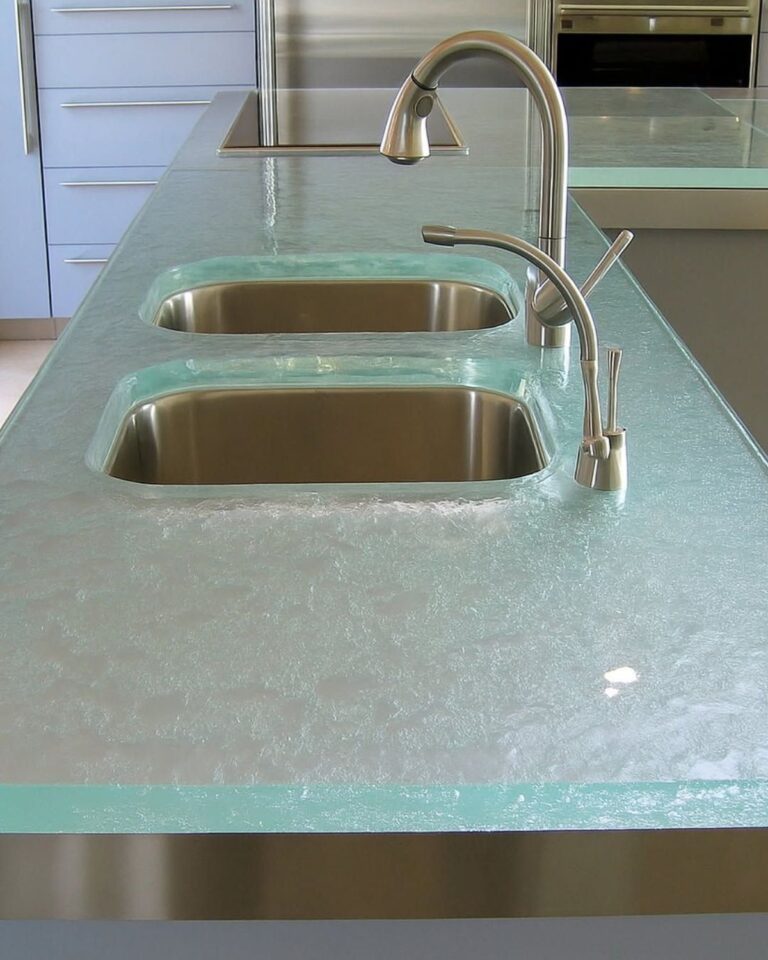
Glass Counter With Integrated Sink Cutouts

The sink is cut directly into the glass slab, with the edges following the same textured finish. The transition between material and fixture stays consistent across the surface.
This removes visual breaks. Instead of switching materials at the sink, the counter stays continuous, which keeps the design clean and controlled.
Outdoor Glass Counter That Reflects the Surrounding Landscape

A thick glass countertop sits on a stone base in an outdoor kitchen, reflecting trees and sky. The transparency and reflections connect the counter to the environment.
This works well outside where materials compete with natural elements. The glass reduces visual weight and allows the surroundings to remain dominant.
Compact Glass Bar Extension for Small Kitchen Layouts

A small raised glass section is added to a compact island, supported by short metal posts. The limited size keeps the design proportional to the kitchen.
This is a controlled way to introduce glass without redesigning the entire space. It adds a seating surface while maintaining the original layout.
Long Glass Counter With Subtle Texture Across the Surface

The glass surface shows a consistent internal texture that diffuses light. The effect adds depth without introducing color changes or strong patterns.
This keeps the design neutral but not flat. The texture provides variation while maintaining a clean, minimal look.
L-Shaped Glass Counter With Continuous Lighting Edge

The glass wraps around the island in an L shape, with lighting running along the entire perimeter. The edge defines the geometry of the layout.
This emphasizes the shape of the kitchen rather than individual elements. The lighting acts as an outline, making the layout easier to read.
Glass Counter Paired With Traditional Cabinetry for Contrast

A classic kitchen base is topped with a modern glass slab, creating a clear contrast between traditional and contemporary elements. The light blue tone stands out against neutral cabinetry.
This mix prevents the space from leaning too far into one style. The glass introduces a modern layer without removing the existing structure.
Elevated Glass Counter With Metal Support System

The countertop is lifted above the base using visible metal supports, creating a gap between layers. The separation makes the glass appear lighter.
This adds depth to the island. The spacing breaks the mass and introduces shadow lines that define the structure.
Thick Glass Slab With Heavy Edge Profile

The countertop uses a thick slab with a pronounced edge, showing the full depth of the material. The surface remains smooth while the edges carry visual weight.
This approach makes the material the main feature. The thickness becomes the design element, not just the surface finish.
Minimal Glass Counter With Clean Corner Connection

A simple glass slab connects cleanly to a side panel, forming a precise corner. The detailing is tight, with no visible excess hardware.
This works in restrained interiors. The focus stays on alignment and proportion, allowing the glass to integrate without dominating the space.