

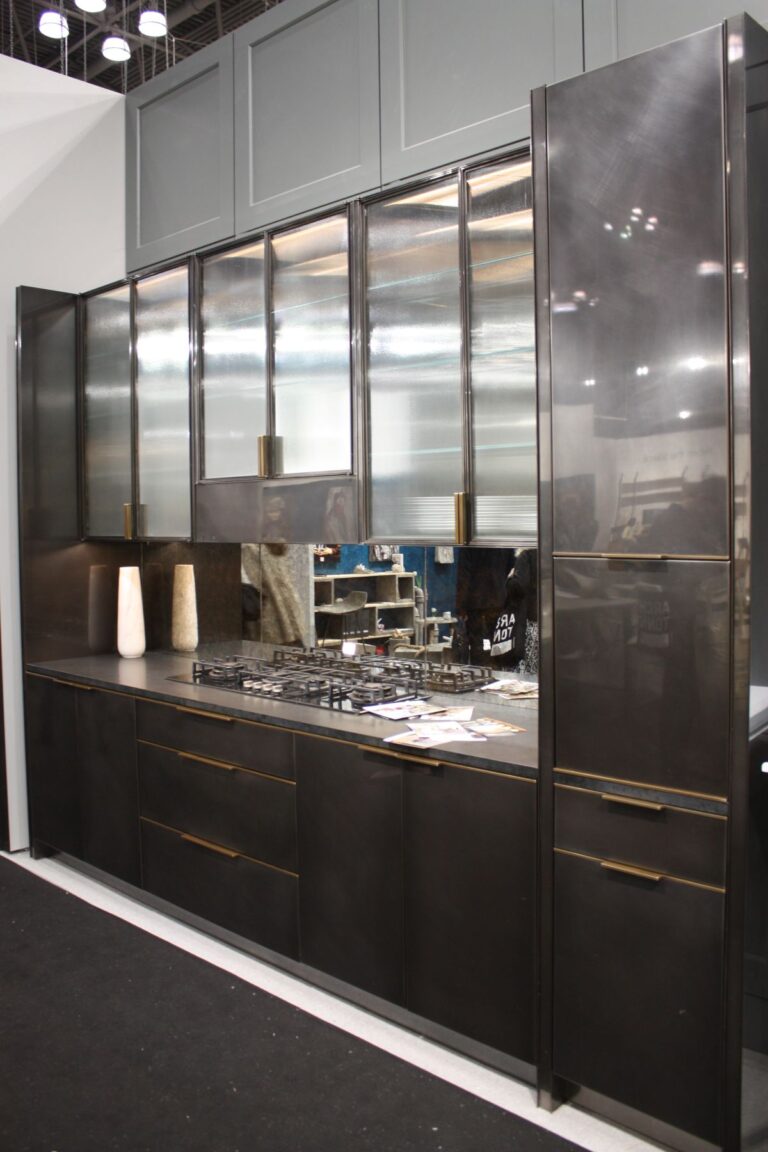


Brass once occupied small spots in the kitchen through cabinet pulls, faucets, and light fixtures. This kitchen takes the material far beyond those familiar uses, carrying metal finishes across cabinetry, shelving, appliance details, and the island.

Instead of adding a few matching accents, the design changes the scale and finish of the metal from place to place. Thin polished lines sit against dark wood, open shelves hang from brass frames, and a hammered metal surface turns the island into the largest metallic feature in the room.
Brass Pulls Break Up the Dark Cabinet Fronts

Long brass pulls run across the dark wood cabinetry, creating narrow horizontal lines without covering the grain. Their slim profile keeps the hardware from competing with the broad cabinet fronts.
The same finish appears on the range and nearby fixtures, connecting separate parts of the kitchen through small metal details.
Thin Metal Trim Outlines the Cabinetry

Brass moves from hardware into the cabinet construction through narrow strips between the dark panels. The metal traces edges and openings, giving each section a defined border.
This approach uses brass as part of the cabinet composition rather than an accessory attached after installation. Wood remains the dominant surface, while the metal establishes a repeating line across the wall.
A Lift-Up Door Turns Brass Into a Cabinet Surface

A brass-toned panel above the sink changes the scale again. Instead of another dark wood door, the metal occupies the full cabinet front and lifts to reveal storage behind it.
The panel sits beside the window, where daylight exposes variations in the finish. Its broad surface makes the metal part of the cabinetry rather than another piece of hardware.
Hanging Shelves Put Brass Above the Countertop

Open glass shelves hang from a brass frame in front of the window, using the upper part of the wall without installing a solid cabinet across the view.
Vertical supports extend from the countertop to the ceiling, while slim horizontal rails hold the glass shelves. Brass becomes structural here, creating storage while leaving light and sightlines open.
Metal Details Continue Around the Cooking Zone

The cooking wall combines dark cabinetry, stone, stainless steel appliances, and narrow brass details instead of assigning a single finish to the entire area.
Brass strips between cabinet fronts repeat the lines seen elsewhere, while stainless steel remains on the range and hood. Mixing the two metals keeps brass from turning into a uniform coating across every fixture and surface.
Brass Moves From Accent to Major Surface

The island pushes the metal idea beyond trim and hardware. Its textured top introduces a broad metallic surface beside the stone perimeter counters, giving the center of the kitchen a finish that stands apart from the surrounding worktops.
Hammer marks create visible variation across the surface, so the metal reads differently from the smooth brass used on pulls and cabinet details. The material stays consistent while its texture changes.
Hammered Metal Makes the Island the Centerpiece

From the dining area, the island shows how much metal the kitchen can carry without turning every surface into brass. Dark cabinetry surrounds the room, pale stone covers much of the perimeter, and the metallic island occupies the center.
That balance explains why brass can move beyond faucets and pulls. Used as trim, framing, shelving, cabinet fronts, and larger surfaces, the same material can perform several jobs without repeating the same treatment.