

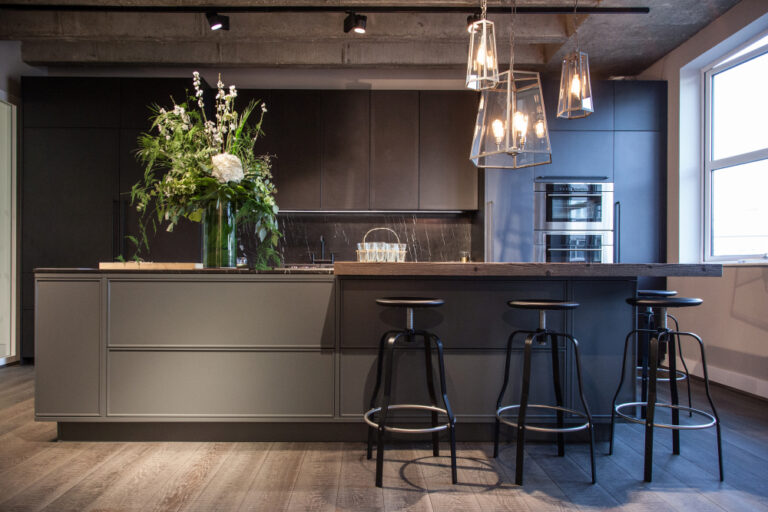

After nearly two decades of working with kitchens, I’ve learned that the spaces people complain about most are rarely the ones that look bad. They’re usually the ones that don’t work. The cabinets are chosen carefully. The island looks right in photos. The finishes are solid. And yet, the kitchen becomes frustrating almost immediately.
In my experience, the issue is almost never visual. It’s how much room exists around the island.
Cabinets define how a kitchen looks. Island spacing determines how it functions. If circulation, appliance clearance, and standing zones aren’t planned properly, no cabinet upgrade will fix it later.

Why island spacing matters more than people expect
A kitchen island sits at the center of daily activity. Everything moves around it: opening the refrigerator, unloading the dishwasher, using the range, walking through the room, or pulling up a stool. When clearances are even slightly off, the kitchen starts pushing back.
One of the most common mistakes I see is treating island spacing like a flexible guideline instead of a fixed requirement. On paper, 36 inches often looks acceptable. In real use, it’s usually where problems begin, especially once appliance doors are open or more than one person is in the space.

Island to cabinets or walls
- 36 inches is the absolute minimum. You can move through, but it already feels tight.
- 42 inches is where the kitchen starts functioning properly and allows two people to pass without stopping.
- 48 inches is ideal for busy kitchens, larger appliances, or households that use the space heavily.
That extra space isn’t wasted. It’s what keeps the kitchen usable when everything is happening at once.
In front of the refrigerator
Refrigerators need more room than most people plan for. A standard-depth model projects into the room, and the door swing alone can block circulation.
- I plan 42 to 48 inches in front of the fridge so the door can open fully and someone can stand there without shutting down the rest of the kitchen. Counter-depth models are more forgiving, but they still need breathing room.
In front of the oven or range
If the oven door opens into a main aisle, 48 inches is the distance that keeps the space comfortable and safe. Anything less quickly becomes awkward, especially when handling hot cookware.
Seating changes the math completely
As soon as seating is added to an island, spacing becomes even more critical. This is where I see many kitchens fail.
- Once stools are in place, I allow 42 to 44 inches or more beyond the island edge. Without that clearance, the aisle effectively disappears the moment someone sits down. The kitchen may look fine, but it stops functioning as intended.
Appliance depth isn’t optional to plan around
Not all appliances behave the same way. Standard-depth refrigerators require more clearance than counter-depth models. Dishwashers and ovens need room not just to open, but to be used while open.
I always plan spacing based on appliances in their open position, not just their closed footprint. When this step is skipped, layouts that looked fine in drawings become frustrating in real life.

The island and the work triangle
An island should support movement between the sink, stove, and refrigerator, not interrupt it. If it forces extra steps, creates bottlenecks, or blocks access, it’s doing the opposite of its job.
I pay close attention to how people naturally move through these zones. If the island cuts across that flow, spacing needs to be adjusted or the island needs to be reconsidered entirely.
Why this matters more than cabinet choices
Cabinets can be replaced. Layout mistakes usually can’t. Once plumbing, electrical, ventilation, and appliance locations are fixed, poor island spacing becomes permanent.
That’s why I treat island clearance as a functional decision first and a design decision second. A kitchen can survive average cabinets. It cannot survive a layout that doesn’t work.
Most people design kitchens by focusing on what they see. I design them by focusing on how the space is used. When island spacing is right, the kitchen works quietly in the background. When it isn’t, every task feels harder than it should.