

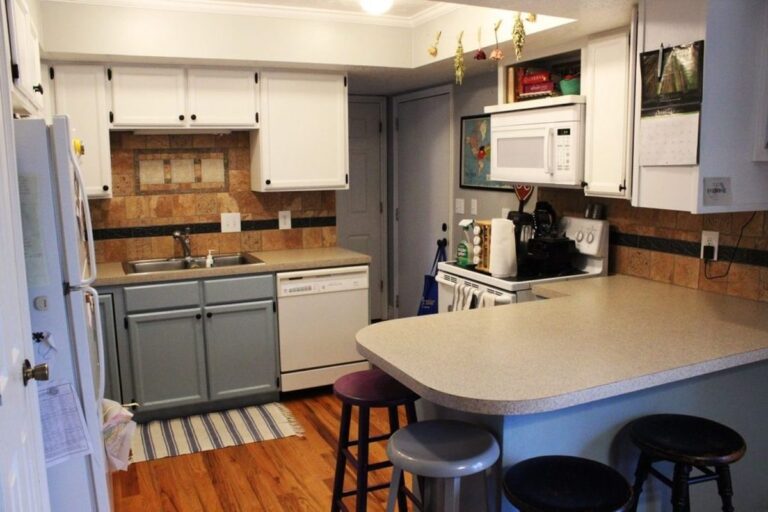


Want a kitchen update that changes the look of the room without replacing the cabinets or tearing out the countertops? Many older kitchens have laminate surfaces that still function well but look worn from scratches, stains, burn marks, and years of use.

This project started with exactly that situation.
Instead of removing the existing countertops and installing new stone surfaces, Brittney Smart covered the old laminate with a concrete overlay made from Ardex Feather Finish. What started as scratched builder-grade countertops ended up looking closer to custom concrete surfaces found in modern kitchens.
The transformation happened layer by layer.
Scratches, Burn Marks, and Worn Areas Covered the Surface


The original countertops showed many of the issues that appear in older laminate kitchens.
Around the sink, the edges showed wear from years of water exposure. Across the surface, scratches, chips, and damaged areas interrupted the pattern and made the countertops look dated.
The structure remained functional, but the finish had reached the point where many homeowners would start shopping for replacements.
Surface Preparation Made the Difference

Before any concrete was applied, the damaged areas received attention.
Loose material, old sealant, scratches, and imperfections needed removal so the new surface could bond properly. Areas around the sink received extra preparation because moisture often creates the biggest challenges there.
This stage looked insignificant, but it determined how well the concrete would hold over time.
Sanding Created a Surface the Concrete Could Grip

The entire countertop received a heavy sanding before the first coat.
The goal was not to make the laminate look better. The sanding created texture across the surface so the concrete underlayment could grip instead of sitting on a slick finish.
Once the dust disappeared, the countertops looked rougher than before, but they were finally ready for the transformation.
The Countertops Started Looking Like Concrete Before They Became Concrete

Instead of using poured concrete, the project relied on a concrete underlayment mixed to a thick consistency.
The mixture looked simple, but it became the material responsible for the entire transformation. Once mixed, it resembled wet cement and could spread directly over the laminate surface.
That single bucket replaced the need for demolition, disposal, and expensive new countertops.
Thin Layers Changed the Surface Completely

The first coat spread across the countertops in thin sections.
Rather than building thickness, the concrete covered the existing laminate and began hiding the original pattern underneath. Trowel marks remained visible at first, and the finish looked uneven.
At this stage the countertops looked worse than when the project started, which is often the point where many DIY projects look unfinished before the transformation appears.
Concrete Covered the Entire Kitchen

As the application continued, the concrete spread across every section of countertop, including the peninsula.
The original laminate pattern disappeared under a continuous gray surface. The kitchen instantly started feeling more modern even before sanding and finishing began.
The large peninsula became one uninterrupted surface instead of a collection of separate countertop sections.
Drying Revealed the New Shape

After drying, the countertops finally looked like concrete instead of wet cement.
The rounded peninsula edge, long work surfaces, and continuous countertop layout became more noticeable once the coating hardened.
The kitchen already felt different, even though sanding and finishing still remained ahead.
Corners and Edges Received Extra Attention

The edges played a major role in the finished appearance.
Concrete wrapped around the front edge of the countertops, helping disguise the fact that laminate still existed underneath. Rounded corners and smooth transitions helped the surface feel more substantial.
Without that step, the project would have looked like a coating rather than a countertop transformation.
Sanding Smoothed the Industrial Finish

Once dry, the surface received another round of sanding.
This stage softened trowel lines, removed imperfections, and created the smooth feel people expect from finished countertops. The concrete started developing the subtle texture often associated with custom concrete installations.
Each sanding pass made the finish feel less like a DIY project and more like a finished surface.
Sealer Added Depth and Protection

Once the concrete had dried and been sanded smooth, the final step focused on protection.
A coat of 511 Impregnator Sealer covered the entire countertop surface, helping protect it against moisture and stains. After 24 hours, a second coat ensured complete coverage across both the countertop and the edges.
Once the penetrating sealer cured, a topcoat of Safecoat Acrylacq created a more durable finish with added resistance to scratches and everyday wear. This final layer also gave the countertops a subtle sheen that helped the concrete feel more finished and kitchen-ready.
The Finished Surface Changed the Entire Kitchen

The final result looked nothing like the original laminate countertops.
The gray concrete surface paired well with the dark cabinets, white appliances, and tuscan backsplash tile. The peninsula became the focal point of the kitchen, and the entire room felt more custom built without replacing a single cabinet.

What started as worn laminate ended up looking closer to a modern concrete countertop installation at a fraction of the cost.
Would you cover existing countertops with concrete, or would you replace them completely during a kitchen update?