

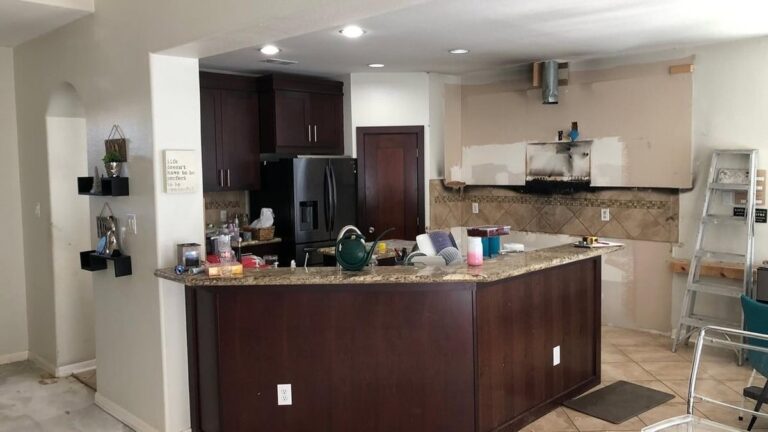


Want a kitchen that looks brighter, stores more, and uses every wall more efficiently? This remodel shared by Instagram account @upperkirby_kitchenandbath started after a fire damaged the cooking area, but the finished result goes far beyond a repair.

Instead of rebuilding what was there before, the project introduced ceiling-height cabinetry, quartz surfaces that continue into the backsplash, integrated lighting, improved storage, and a lighter material palette. Dark cherry cabinetry, granite countertops, and tile flooring gave way to natural wood finishes, white quartz, and a cleaner layout built around storage and function.
What started as fire damage became a complete kitchen transformation.
Dark Cabinetry Dominated the Original Layout

Before construction began, dark cherry cabinetry wrapped around the room and covered a large angled island. Granite countertops and beige tile flooring added another layer of visual weight.
The kitchen offered generous workspace and storage, but the darker finishes drew attention away from the room’s size and natural light.
Fire Damage Removed the Original Cooking Wall

Damage around the range required much of the cooking wall to be removed. Cabinets, venting, and surrounding finishes were stripped away, exposing the wall structure behind them.
Rather than replacing only the damaged section, the remodel became an opportunity to rethink storage, work surfaces, and the overall appearance of the kitchen.
Cabinets Reached the Ceiling and Storage Expanded

One of the largest upgrades came from the cabinetry.
Modern Shaker cabinets in a timber stain now extend almost to the ceiling, adding an extra row of storage above the primary cabinets. Areas that once collected dust now provide usable storage space.
The added height also gives the kitchen a more built-in appearance.
Quartz Replaced Granite Across the Kitchen

Dark granite countertops were replaced with bright quartz surfaces throughout the room.
The lighter material reflects more daylight and creates stronger contrast against the cabinetry. Quartz now appears across multiple work zones, helping connect different sections of the kitchen.
The change shifts attention away from individual surfaces and toward the overall design.
Island Lost Its Angles and Gained More Function

The original island relied on multiple angled sections and projections.
The replacement uses cleaner lines while providing seating, preparation space, and additional storage. The simplified shape improves circulation and reduces visual clutter near the center of the room.
The island now functions as the primary gathering and work area.
Black Fixtures Stand Out Against White Quartz

A black sink and matching faucet create one of the strongest contrasts in the remodel.
Placed near the center of the island, the fixtures draw attention without introducing additional materials or colors. The dark finish also connects with hardware used throughout the kitchen.
The contrast helps define the island against the surrounding quartz surface.
Quartz Continued Up the Wall

Instead of stopping at the countertop, quartz now extends across the backsplash.
The continuous surface removes grout joints and visual interruptions behind the cooking area. Subtle veining introduces texture while maintaining a clean appearance.
The wall now reads as one uninterrupted surface.
Pull-Out Spice Storage Filled Narrow Gaps

Storage improvements extend beyond the visible cabinetry.
Pull-out organizers beside the range convert narrow spaces into dedicated storage for spices, oils, and cooking essentials. Items remain accessible without consuming drawer space elsewhere in the kitchen.
The feature increases storage capacity without requiring additional floor space.
Cooking Wall Became a Focal Point

The redesigned cooking wall relies on symmetry.
Tall upper cabinets frame the range while wide drawer banks provide storage below. Black hardware and a black vent hood create contrast against the lighter cabinetry and quartz backdrop.
The arrangement gives the cooking area a stronger visual identity.
Under-Cabinet Lighting Work Surfaces

LED lighting installed beneath the upper cabinets brightens the work surface without requiring additional fixtures. The continuous quartz backsplash remains free of interruptions, helping the wall appear cleaner and more unified.
Angled power outlets mounted beneath the cabinets keep plugs accessible while removing most visible receptacles from the backsplash. The solution preserves functionality while allowing the quartz surface to remain the primary visual feature.
Refrigerator Became Part of the Cabinet Wall

Cabinetry now surrounds the refrigerator and extends into the space above it.
Instead of leaving exposed gaps, the millwork integrates the appliance into the overall design. Additional drawers and cabinets contribute more storage while maintaining visual consistency.
The refrigerator appears connected to the kitchen rather than placed beside it.
White Quartz Connected Every Work Zone

From this angle, the relationship between the island, perimeter counters, and storage walls becomes clear.
Quartz surfaces repeat throughout the kitchen while the timber cabinetry provides consistency across each section. The repeated materials allow the room to read as one coordinated space.
Each work zone now connects to the next.
Lighter Finishes Changed How Light Moves Through the Room

Natural light from the surrounding windows now reflects across the quartz surfaces and lighter cabinetry.
Where darker finishes once absorbed much of that light, the updated palette distributes it across the room. The change improves the appearance of the kitchen throughout the day without altering any windows.
The room appears brighter despite keeping the same footprint.
Fire Damage Led to a Complete Redesign

The fire may have started the project, but the finished kitchen shares little with the room that existed before.
Cabinetry, countertops, storage planning, lighting, flooring, and the island were all reconsidered during the rebuild.
Before and After Reveal the Full Transformation

Comparing the before and after photos shows how much changed without expanding the kitchen itself.
Storage now reaches near the ceiling, quartz surfaces run across the counters and backsplash, lighting improves visibility, and the island serves as a stronger centerpiece for daily use.
Would you have rebuilt the original dark kitchen, or taken the opportunity to redesign the entire space like this?
All images belongs to Instagram account @upperkirby_kitchenandbath.