



Cabinet handles used to be one of the last choices made in a kitchen, picked after the door style, color, countertop, and appliances were set. A small pull or knob finished the cabinet without asking for much attention.

The kitchens below show a different approach. Handles stretch across wide drawers, run down tall cabinet doors, repeat in stacked rows, or sit close to cabinet edges so the hardware becomes part of the lines already built into the room. Some pulls are almost as wide as the drawer fronts they open, while others use brass, black steel, or curved forms to create contrast against plain doors.
The result changes how cabinet hardware reads from across the room. Instead of looking like something attached after the cabinets were installed, the handle starts to shape the cabinet itself.
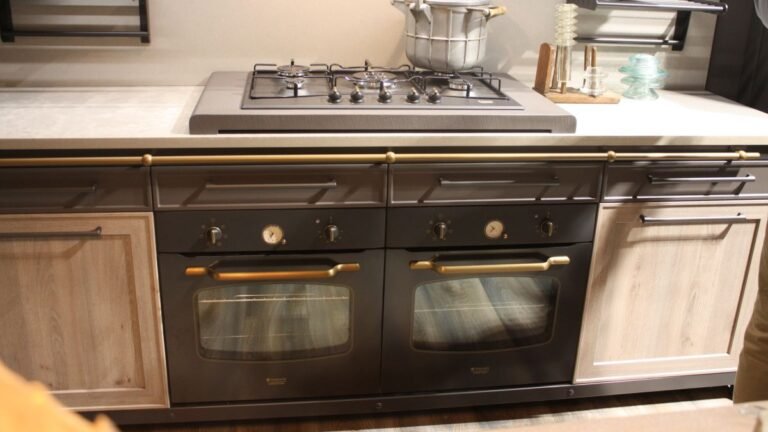
Long brass pulls break up a full wall of wood cabinetry

Tall wood cabinets can become one broad block when every door uses the same grain and finish. Long brass pulls divide the lower section into clear horizontal bands, while the black wall ovens create another break across the center of the run.
The handles cover much more of each drawer front than a standard pull would, which gives the lower cabinets enough weight to balance the large wood panels above. Brass also stands out against the oak without competing with the black glass appliances.
Stacked handles turn drawers into horizontal bands

This white cabinet wall uses several long pulls across drawers placed under a bank of black appliances. Instead of treating each drawer as a separate box, the repeated hardware creates lines that run across the lower half of the wall.
The same idea appears on the tall refrigerator panels at both ends, where long handles sit close to the lower edge. Their size keeps the hardware in proportion with cabinet doors that extend close to the ceiling.
Half-moon pulls replace the usual bar handle

Not every larger handle needs to be a straight metal bar. These wide half-moon pulls sit along the top edge of the drawer fronts, creating dark arcs across a pale cabinet run.
Because the pull shape cuts into the visual outline of the drawer, the hardware feels tied to the front instead of placed on top of it. The curved form also gives the long run a break from the straight countertop, backsplash, and cabinet joints.
Extra-long pulls stretch across dark cabinet fronts

Dark slab cabinets can hide small hardware once the room is viewed from several feet away. Here, long metal pulls extend across a large share of each drawer and cabinet front, so the handle stays visible against the charcoal finish.
Their position near the upper edge reinforces the horizontal line of the countertop. On the wall cabinets, the long rail under the doors carries the same idea across the backsplash zone.
Wide pulls give an island its own grid

A wide island already creates a strong horizontal shape, and these long stainless pulls follow that proportion rather than breaking it into small hardware points. Each drawer gets a bar wide enough to read from the opposite side of the room.
The repeated pulls also show how hardware can organize a bank of drawers. Even with dark fronts and little trim, the metal bars create a visible grid that separates each storage section.
Vertical handles make tall cabinets look even taller

Horizontal pulls dominate many drawer-heavy kitchens, but tall cabinet doors can benefit from the opposite move. Long vertical handles draw the eye from the floor toward the upper cabinets and reinforce the height of the storage wall.
The dark metal also connects the pale concrete-look fronts with the black shelving and hood above. On the wood cabinet at the end, the same handle shape keeps two different door finishes within one system.
Glossy red cabinets need hardware that can hold its own

Small pulls would disappear against these high-gloss red drawer fronts. Long black handles create enough contrast to cut through the saturated color and match the dark countertop and cooktop.
Their width also prevents the large island drawers from looking bare. Each bar occupies enough space to become part of the drawer composition rather than a small functional piece placed in the center.
Metal handles can connect wood cabinets with a steel backsplash

Wood fronts, stainless counters, a steel backsplash, and black-framed glass cabinets bring several materials into this kitchen. Long metal pulls help bridge those surfaces by repeating the finish of the worktop and appliances across the lower cabinets.
The hardware stays slim, so it does not compete with the backsplash panels or the glass doors above. Its length matters more than its thickness, which keeps the cabinet faces clean while adding another horizontal line.
Slim pulls can still change how wide drawers read

This gray and white kitchen does not use oversized hardware, but the handles still stretch far enough to follow the width of each drawer. The lower cabinet run reads as a sequence of horizontal layers instead of a row of boxes with small pulls in the center.
Matching metal handles on both cabinet colors also connect the white base units with the gray uppers. The hardware becomes the repeated element across a two-tone cabinet scheme.
Curved edge pulls almost disappear into the drawer fronts

Wide drawer fronts do not always need a bar mounted across the face. These dark curved pulls sit at the top edge of each drawer, leaving most of the front untouched while creating a shadow line where the hand reaches in.
The shape works well with the broad drawers because each pull follows a large section of the edge. From across the room, the hardware reads more like part of the drawer construction than a separate accessory.
Brass hardware turns storage into part of the display

Brass pulls on the lower cabinets match the metal frames supporting the glass shelves above the sink. That connection pushes the hardware beyond a cabinet-only detail and carries one finish from storage to display.
The pulls are shorter here than in several of the other kitchens, but their color gives them more presence. Against gray wood fronts, brass marks each door and drawer while tying the base cabinets to the open shelving overhead.
Handles can echo the shape of a much larger kitchen feature

Curved silver pulls on these oak drawers repeat beneath a huge hood trimmed with a thick wood band. The cabinet hardware does not match the hood in scale, but both use broad curves that soften the sharp edges of the island and countertop.
The same pull repeats across a bank of drawers, turning a practical grip into a pattern. Against the oak grain, the silver finish stays visible without taking attention away from the wood.
Bold appliances can change what cabinet hardware needs to do

Red double ovens dominate this green cabinet wall, so the hardware does not need to become the main feature. Brass pulls and knobs support the stronger color choices while connecting the green doors with the copper hood beside the range.
This kitchen also shows why bigger does not mean every cabinet needs the longest handle available. Scale works when it responds to the doors, drawers, appliances, and other metal finishes around it. The broader shift is that cabinet hardware is being chosen as part of the cabinet composition, not as a small piece added after the rest of the kitchen is done.