



Kitchen appliances once announced themselves through large range hoods, raised burners, banks of controls, and machines that interrupted cabinet runs. These kitchen designs take another route, putting ventilation inside the island, reducing cooktops to thin glass surfaces, fitting appliances into wall panels, and moving lighting and storage systems inside drawers.

Technology has not left the kitchen. More of it now sits inside the surfaces and fixtures people already use, appearing when cooking, cleaning, or storage calls for it and giving the rest of the kitchen back to the cabinets and countertops.
Ventilation rises from the island when the cooktop needs it

Miele’s retractable ventilation system replaces the large hood that would sit above an island cooktop. The unit rises from a slot behind the induction surface, putting extraction close to the pans while leaving the ceiling above the island open.
Once cooking ends, the hood can retract into the island instead of remaining in the sightline. That changes more than the appliance itself: pendant lights, open views, and ceiling details no longer have to compete with a permanent ventilation box.
French doors put more refrigerator storage within reach

Miele’s French-door refrigerator divides a large cold-storage cavity into several access points, with shelves and bins mounted across both upper doors and separate compartments below. Opening one side gives access to part of the refrigerator instead of exposing the full interior behind one oversized door.
Interior lighting, door storage, adjustable shelves, and lower drawers pack more functions behind a cabinet-size facade. The refrigerator still occupies substantial space, but much of its technology has moved behind the doors rather than onto the exterior.
Wall appliances become one built-in block

Gaggenau groups several appliances into a flush wall installation where stainless steel fronts, glass openings, and controls share the same grid. Instead of placing separate machines around the kitchen, the system concentrates them within one bank of cabinetry.
Large surrounding panels reinforce the effect because the appliances sit on the same plane as the wall rather than projecting into the room. Ovens and specialty appliances remain visible when needed, yet the installation reads as one architectural section rather than a collection of machines.
Gas burners no longer need one large cooktop

Cesar breaks the conventional gas cooktop into individual circular burners installed across the counter. Each burner has its own grate and support, leaving countertop visible between the cooking zones instead of filling the area with one rectangular metal appliance.
Controls are grouped at the side in a compact row, which removes another large appliance panel from the island. The setup shows how even gas cooking can become part of the worktop rather than sitting on top of it as a separate range.
Drawer lighting puts the technology inside the storage

Crown Point Cabinetry moves lighting into the drawer itself, illuminating a fitted spice system as soon as the storage area is exposed. Metal containers sit in individual slots beside divided compartments, so the drawer combines storage, organization, and task lighting in one cabinet component.
Nothing needs to occupy the countertop or wall above it. The useful technology stays inside the cabinetry and serves the contents of the drawer instead of becoming another visible kitchen device.
Refrigerator hardware becomes part of the appliance design

True takes a different route with its matte black refrigerator. The appliance does not disappear behind matching cabinet panels, but its dark surface reduces the visual breakup associated with stainless steel doors while long copper-toned handles run almost the full height of the refrigerator.
Ventilation is contained in matching black panels above the doors, while a narrow glass section reveals part of the refrigerated interior. Instead of hiding the entire machine, the design consolidates its working parts into one tall block that can sit beside cabinetry without looking like several stacked appliance components.
One cooking surface handles specialized cookware

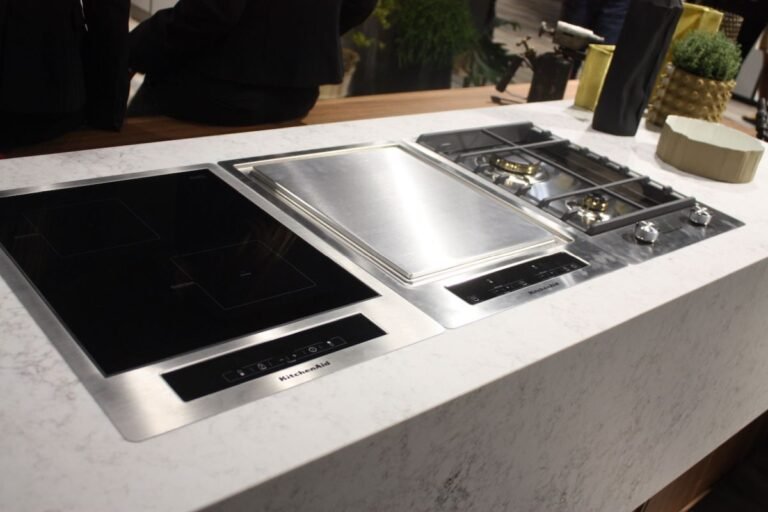
Wolf’s modular cooking setup combines standard gas burners with a recessed center designed for wok cooking. The specialized burner is integrated into the same cooking plane, eliminating the need for a separate countertop wok burner or another appliance stored elsewhere.
Different cooking functions occupy defined sections of one station, while the controls sit across the front rather than consuming counter space. Modular systems like this make the range less about one fixed burner arrangement and more about building the cooking surface around the tasks used in the kitchen.
Countertop appliances become objects meant to stay out

Smeg represents the other side of the shift. Mixers, toasters, kettles, and juicers are difficult to integrate into cabinetry because they need to move, open, and connect to outlets, so their rounded cases and saturated colors turn exposed appliances into part of the kitchen display.
That approach matters in a kitchen where larger equipment is becoming less visible. Once ovens, ventilation, and cooking surfaces merge into walls and counters, the few appliances left on display can carry more of the room’s color and shape.
Faucet technology moves into the fixture itself

Brizo’s faucet combines a high flexible neck, articulated metal arm, and touch controls within the fixture rather than adding a separate control panel around the sink. The jointed mechanism lets the spray head move across the basin while the electronic function remains inside hardware that already needs to be there.
Sink technology becomes less about adding devices beside the faucet and more about expanding what the faucet itself can do. The result keeps the deck around the basin open while putting control and movement within reach.
Induction turns the cooktop into a sheet of glass

Siemens induction removes most of the physical parts associated with a traditional cooktop. Burners sit beneath one black glass surface, touch controls occupy a narrow section of that same panel, and nothing rises above the counter when no cookware is present.
That flat profile matters on an island or long counter because the cooking zone stops creating a physical obstacle across the worktop. There are no grates to break up the surface and no knobs extending from the edge, leaving one defined glass rectangle as the only visible sign of the appliance.
Island ventilation appears only when cooking starts

Stosa pairs a flush cooktop with a ventilation panel that rises from the counter beside the pans. Extraction moves down to cooking level instead of requiring a hood suspended from the ceiling, preserving the open space above the island.
When the ventilation system retracts, cookware and the cooktop become the main visible elements of the cooking zone. Between this system and Miele’s version, the direction is clear: some of the largest kitchen equipment no longer needs to remain visible after its job is done.