

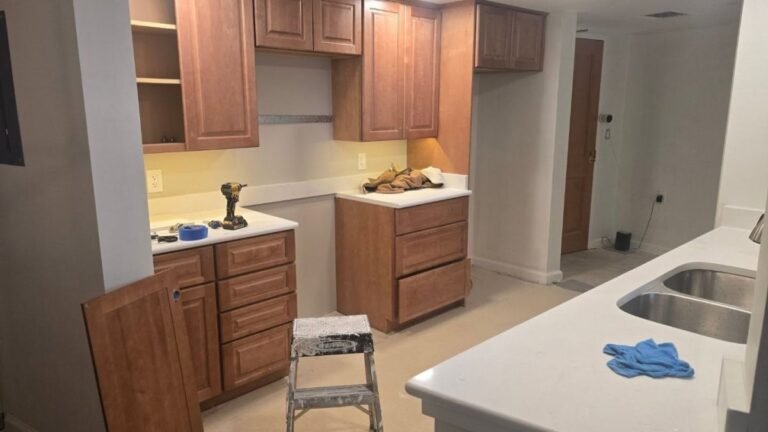


Brown stained cabinetry dominated this kitchen, covering almost every visible cabinet surface from the floor to the crown molding. Against the white counters and stainless steel appliances, the warm wood became the feature your eye landed on first.

Instagram creator @mikeyamusic didn’t tear the cabinets out. He removed the doors and drawer fronts, masked off the kitchen, and used blue paint to change what was already there.
Once everything went back together, the brown cabinet wall was gone. Deep blue now surrounds the same range, microwave, refrigerator, and white counters, while a new geometric backsplash changes the space behind them. Look closer at the before and after, though, and much more of the original kitchen survived than the finished result suggests.
Brown Stain Covered the Cabinet Doors, Frames, and Trim

Raised-panel doors gave the original cabinets a traditional profile, with brown stain covering the doors, face frames, end panels, toe kicks, and crown trim. Small metal knobs and curved drawer pulls broke up the wood without changing its dominant brown tone.
White countertops were already in place on both sides of the range. Stainless steel on the microwave, range, and refrigerator also gave the project several finishes worth keeping, putting the focus on the cabinetry rather than a full tear-out.
Doors Came Off While the Cabinet Boxes Stayed

Removing the doors exposed the cabinet interiors and made the extent of the reuse clear. Upper boxes remained attached to the wall, while the base cabinets stayed beneath the existing counters. Drawer fronts and doors came off so the exposed frames could receive paint.
The opening for the range remained between the two base sections, as did the refrigerator recess at the right. No new cabinet configuration was needed to create the change seen in the finished kitchen.
Paper and Tape Protected Everything That Wasn’t Getting Paint

Brown paper covers the upper cabinet openings, while blue painter’s tape seals the edges around each frame. Countertops sit beneath plastic sheeting, and the drawer openings and electrical outlets also receive protection.
Masking lets paint cover the visible cabinet surfaces without coating the interiors. Crown molding, face frames, end panels, and lower cabinet fronts could then receive the same blue finish while the wood inside remained intact.
Blue Paint Covered the Frames Before the Doors Went Back

With the masking removed from the cabinet interiors, the new color becomes clear. Blue now runs across the crown trim, face frames, cabinet sides, base units, and the wall section between the two lower cabinet runs.
Bare wood still shows on the removed drawer fronts and inside the open cabinets. That contrast makes it easy to see how much of the original cabinetry remains beneath the new finish.
Raised-Panel Doors Returned in Blue

Once the doors and drawer fronts went back, the original cabinet design returned with none of the brown stain visible on the exterior. Paint carries across the recessed panels, rails, stiles, frames, and trim, making separate wood surfaces read as one blue installation.
Existing white counters now sit against blue base cabinets, while stainless steel appliances break up the long cabinet wall. Silver-toned knobs and pulls keep the hardware tied to those appliance finishes.
White Geometric Tile Replaced the Plain Wall Behind the Range

The backsplash adds another change without competing with the cabinet color. Long white hexagonal tiles span the wall between the countertop and upper cabinets, with pale grout keeping the individual shapes visible.
Around the range, the tile continues beneath the microwave and across both counter runs. The white surface connects with the existing countertops, while its geometric joints add a pattern that the old wall lacked.
Same Cabinet Layout, Different Finish

The finished view confirms how little had to move. Tall cabinets still flank the microwave, drawers remain on both sides of the range, and the upper cabinet above the refrigerator occupies the same spot.
Paint changed every visible wood surface without hiding the raised-panel construction that was already there. Instead of replacing the cabinets to get a different kitchen, the project used their existing proportions and storage as the base for the new blue finish.
Paint or Stain? The Same Cabinets Show Both

The side-by-side view puts both finishes on the same raised-panel cabinets. Stain leaves the wood grain visible across the doors and frames, while blue paint covers it and turns the separate cabinet surfaces into a more uniform wall of color.
The cabinet style never changed, which makes the comparison less about replacing what was there and more about what a new finish can do.
Which would you choose for these cabinets: stain or blue paint?
Image credits go to Instagram creator @mikeyamusic.