



More pantry shelves do not always mean more usable storage. In this walk-in pantry, the upper half relies on adjustable wood shelves, while the lower section switches to pull-out mesh baskets that bring stored items forward instead of leaving them near the floor behind another row.

The surrounding shelves use a different organizer for each type of food. Produce sits in open baskets, pasta moves into clear containers, small jars rise on a stepped rack, and bottles sit on a rotating tray.
Open Baskets Keep Produce Separate From Dry Goods

Two white wire baskets hold oranges and lemons on a shelf between dry pasta above and clear storage bins below. The open construction makes the produce visible from the front and sides, while wood handles give each basket a solid grip when it needs to come off the shelf.
Clear rectangular bins on the level beneath contain smaller containers and glass bottles. Instead of letting loose items spread across the full width, each group occupies its own removable bin.
Container Height Determines How Much Space Each Shelf Needs

This section shows why adjustable shelves matter. Tall pasta canisters fill much of the lower opening, while the shelf above accommodates shorter clear bins, lemons, and rows of bottled water.
Metal standards run up both sides of the shelving, so the brackets can move to another slot when taller or shorter storage takes over. The pantry does not have to keep the same gap between every level.
High Shelves Use Baskets That Can Come Down as One Piece

Large perforated bins occupy the highest shelf, with two open wire baskets beneath them. Both types have handles, which matters once storage moves above comfortable reach.
Instead of placing several loose packages on the top level, a basket can hold them as one group and come down with one lift. The open baskets below can serve the same purpose for items that do not need enclosed sides.
Pull-Out Mesh Baskets Replace the Lowest Fixed Shelves

The biggest change appears at the bottom. Four wood-framed levels contain white mesh baskets that slide out from the wall-mounted system. Their fronts match the pale wood shelves above, but the storage beneath works more like a set of drawers.
Pulling a basket forward exposes its depth at once. Food stored near the back does not require reaching past a front row or searching across a shelf close to the floor. The mesh sides also keep the contents visible after the basket comes out.
Tiered Storage Gives Small Jars Their Own Sightline

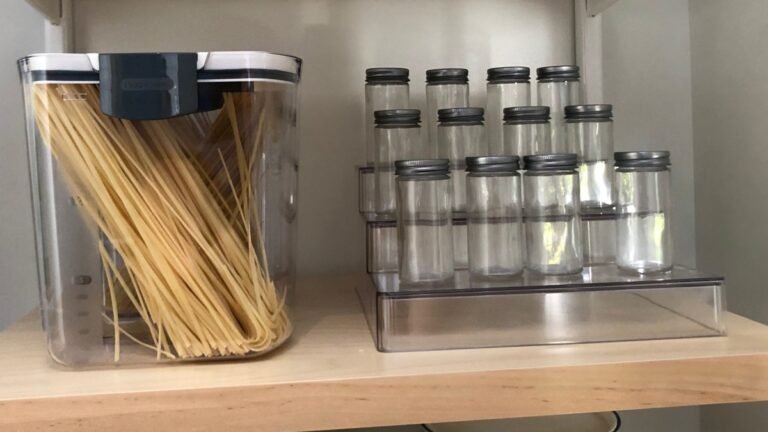
A tall spaghetti container occupies one side of this shelf, while small glass jars sit on a stepped clear organizer beside it. Each row rises above the row in front, so the jars at the back remain visible.
The photo also shows the range of container sizes accommodated by the same shelving system. Large white bins sit at the top, tall clear bins fill another level, and smaller containers use an insert rather than demanding a separate shelf.
A Turntable Uses Depth Without Creating a Hidden Back Row

A two-level clear turntable fills one side of the shelf with bottles and small jars. Rotating the tray brings items from the rear around to the front, which avoids the usual problem of bottles disappearing behind each other.
Wood-lidded jars fill the space beside it, with stacked pasta containers at the right. Each organizer addresses a different shape: the round tray handles narrow bottles, vertical jars use the center gap, and rectangular containers sit against the edge where their straight sides waste less shelf space.
The pantry does not solve every storage problem by adding another horizontal surface. Adjustable shelves handle changing heights, baskets group loose items, risers expose small containers, a turntable reaches into shelf depth, and the lowest section abandons fixed shelving where access becomes harder.