

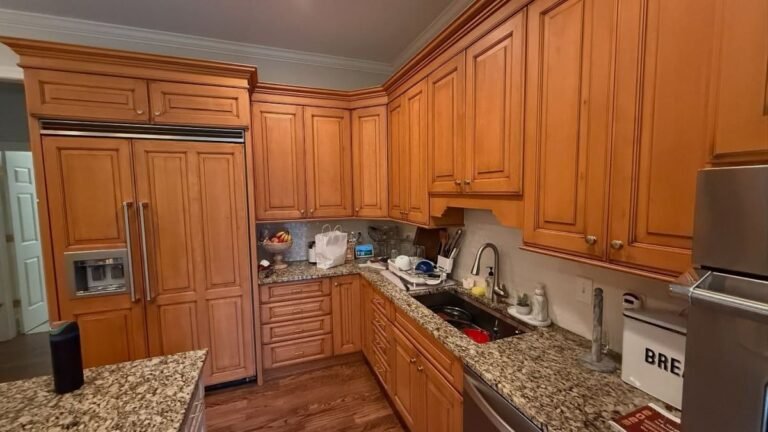


Oak covered almost every major storage surface in this kitchen. Raised-panel doors ran around the sink, refrigerator, double ovens, island, and a separate floor-to-ceiling cabinet wall, while matching crown molding carried the wood finish above them.

Instagram creator @pezzottipainting kept the cabinetry and spray painted it Sherwin-Williams Dover White using Centurion Wood Coatings 400 Series. Once the oak grain disappeared, details that had blended into the wood became much easier to spot.
No new door style was needed. The raised panels, stepped crown, refrigerator surround, appliance towers, open shelves, granite counters, hardwood floor, and original layout were already there.
Oak Filled the Kitchen From Floor to Crown

Raised-panel oak doors surround the sink, dishwasher, double ovens, and refrigerator, with more cabinetry continuing onto the island. Even the refrigerator is enclosed by matching wood panels rather than left as a separate stainless steel block.
The crown molding matters here too. Oak runs above the doors and around the corners, putting the same finish across cabinet fronts, trim, fillers, and appliance surrounds.
Refrigerator Panels Almost Disappear Into the Cabinet Run

From this angle, the refrigerator is easy to miss at first. Tall raised-panel doors conceal most of it, while matching cabinets fill the space above and beside it.
The sink wall turns the corner without breaking the cabinet style. Dover White would later make that built-in refrigerator treatment stand out more than it does among the repeating oak grain.
Cabinet Details Were Already Hiding in the Oak

The close-up reveals beveled door edges, narrow corner doors, layered crown molding, and trim running across the cabinet tops. None of those details were added during the update.
With oak across every surface, the grain competes with the profiles. Removing that grain leaves the shadows around each raised panel and molding edge to define the doors instead.
Another Cabinet Wall Was Built Like Furniture

Across the room, two tall storage towers frame open shelves, a granite counter, and a built-in oven. Crown molding projects above each tower, while a decorative cutout finishes the opening over the shelves.
That entire arrangement already existed in oak. Even the shelves and interior of the center niche matched the cabinet doors before paint entered the picture.
Spraying Reached More Than the Cabinet Doors

The process image shows why the finished cabinets read as one continuous installation. Appliances, counters, backsplash, openings, and surrounding surfaces were masked while the fixed cabinet frames were coated in place.
White spreads across face frames, end panels, trim, crown molding, and the narrow strips between openings. Covering those fixed parts prevents strips of oak from remaining between the refinished doors.
Dover White Revealed the Existing Architecture

With the doors back in place, the refrigerator surround becomes one of the strongest features on the wall. Tall panels frame the appliance, crown molding caps the enclosure, and matching cabinets continue toward the sink and ovens.
Granite counters and stainless steel appliances did not change. Dover White puts more contrast between those surfaces and the cabinet structure around them.
Same Sink Wall Looks Far Less Wood-Heavy

Compare this view with the original and almost every line matches. The sink remains under the same upper cabinets, the dishwasher stays beside it, the double ovens occupy the same tower, and granite still runs across the counters.
What changes is how much wood the eye sees at once. Hardwood remains underfoot, but it no longer continues up the cabinet fronts and toward the ceiling.
Raised Panels Stand Out More Without Wood Grain

Dover White makes the construction of the doors easier to read. Each recessed center is surrounded by a beveled frame, and the shadows along those edges now provide the contrast that wood grain once supplied.
Small warm-metal knobs break up the white without covering the profiles. The doors look different, yet their shape has not changed.
Small Knobs Become More Visible Against Dover White

A close view shows how little hardware is needed across these detailed fronts. Round metal knobs sit near the inner corners while most of each door remains uninterrupted.
Against oak, the hardware sat among several similar brown and gold tones. Dover White gives each knob a defined outline and puts more attention on the molding around it.
Open Shelves Changed Along With the Cabinet Towers

Dover White continues inside the open shelving niche rather than stopping at the tall cabinet doors. Shelves, side walls, decorative cutout, base trim, and crown now share the same finish.
The granite counter and built-in oven stayed. Painting the center section prevents an oak rectangle from surviving in the middle of the new white cabinet wall.
Island Paint Separates the Cabinets From the Hardwood

The wide view reveals another change that required no new material. Before, oak flooring and oak cabinetry occupied much of the lower half of the room. Now the hardwood reads as a separate surface beneath the Dover White island and perimeter cabinets.
The long granite island, cooktop, appliances, and cabinet configuration remain in place. White changes the boundary between the existing materials rather than replacing them.
Crown Molding Gives Away the Cabinets’ Original Identity

Up close, the original cabinet work is still easy to trace. Stepped crown molding follows the ceiling, raised panels retain their beveled edges, and the same face frames divide each door.
At first glance, the finished kitchen can suggest new cabinets. Look closer and the refrigerator panels, appliance towers, open shelves, island, door profiles, and crown molding all match the oak version.
Dover White did not create those cabinet details. It made the ones already there much easier to see. Would you have painted all that oak, or kept the original wood finish?
All credits go to Instagram creator @pezzottipainting.