



Wood cabinets filled both levels of this kitchen, extending from the sink and peninsula to the tall pantry and refrigerator surround. Instead of painting every cabinet the same color, the existing cabinetry was split at counter height during a makeover shared by Instagram creator @jvprofessionalpainting.

White now covers the upper cabinets and tall storage, while blue runs across the base cabinets, sink area, appliance station, and peninsula. The white countertops, dark backsplash, stainless steel appliances, metal pulls, open wood shelves, and dark flooring remain, allowing the new color division to change the kitchen without changing its cabinet layout.
Wood Cabinets Covered Both the Upper and Lower Half

Before paint, the refrigerator wall shows how much of the kitchen shared the same wood finish. Cabinetry fills the space beside and above the refrigerator, with another bank of upper and lower cabinets creating a small appliance station.
The raised-panel doors, crown molding, and long metal pulls were already present. Painting rather than replacing them keeps those details while removing the repeated wood tone across the wall.
Even the Peninsula Shared the Same Finish

Wood continued onto the peninsula, where wide drawers sit beside a narrow cabinet. Matching end panels carried the finish around the exposed side beneath the white countertop.
This section matters once the blue is introduced because it becomes part of the lower color band rather than a separate block of cabinetry.
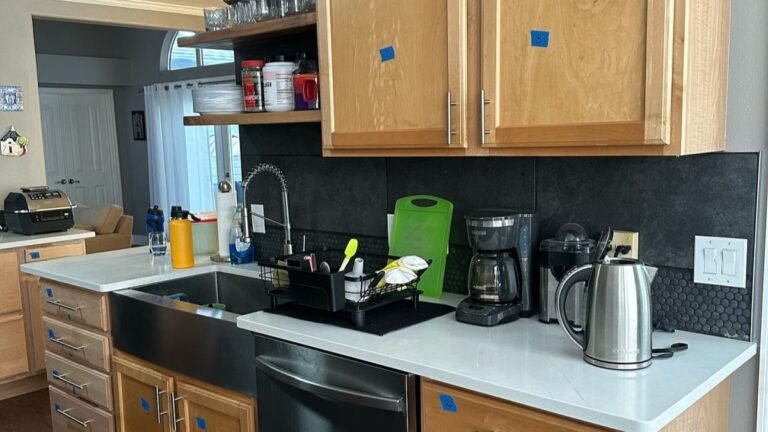
Wood Also Surrounded the Sink and Dishwasher

The sink wall repeated the same cabinet finish above and below the counter. Two arched upper doors sit over the coffee area, while wood base cabinets frame the stainless dishwasher and farmhouse sink.
Dark backsplash tile and white counters were already creating contrast, but the wood cabinetry connected the upper and lower halves into one continuous finish.
White Took Over the Tall Cabinets and Uppers

After the makeover, white covers the tall pantry, wall cabinets, and cabinetry above the refrigerator. The existing door profiles remain visible, including the arched panels that were much more pronounced against the original wood grain.
Blue was reserved for the base cabinets at the appliance station. That single section introduces the two-tone scheme without carrying blue up either side of the refrigerator.
Blue Runs Across the Lower Cabinets

The blue becomes more prominent along the sink run and peninsula. Drawers, sink cabinets, dishwasher surrounds, and exposed end panels now share the darker color, creating a continuous band below the countertop.
White upper cabinets sit against the dark backsplash, while the existing wood shelves beside them were left exposed. Those shelves preserve a small amount of natural wood and connect with the brown flooring rather than removing every wood surface from the kitchen.
White Uppers and Blue Lowers Meet at the Counter

From this angle, the two-tone division follows the countertop across the kitchen. White stays above, blue stays below, and the white counter forms a narrow break between the two colors.

Keeping the stainless dishwasher, farmhouse sink, black backsplash, counters, and cabinet hardware also shows how much can change without altering the kitchen layout. The cabinetry has the same doors and positions as before, but splitting the paint colors changes how the upper and lower sections read.
Would you choose blue for the lower cabinets, or use the same white across the entire kitchen?
Image credits go to Instagram creator @JV Professional Painting