

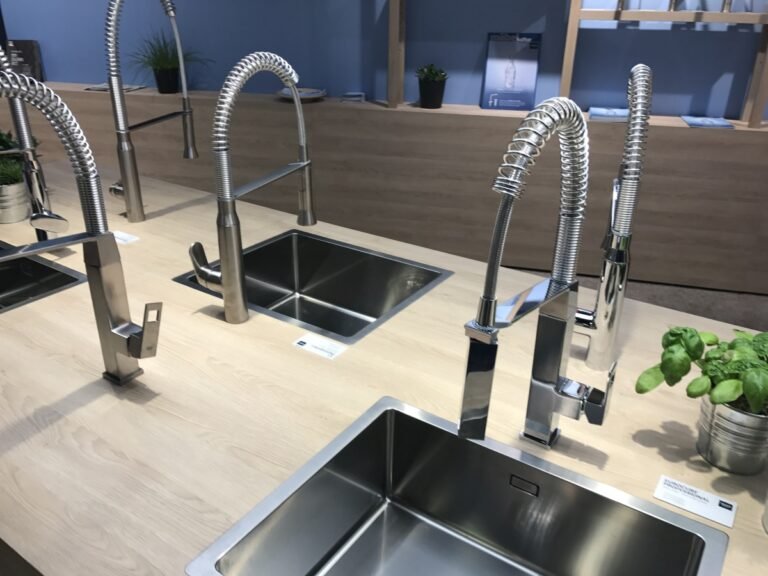


Curved faucets still dominate kitchen sinks, but the familiar arch is no longer the only shape competing for space above the basin. Square bends, horizontal spouts, spring coils, pull-out heads, and separate sprayers change both the silhouette and the way water reaches the sink.

Some designs strip the faucet down to a few straight sections. Others borrow from restaurant kitchens or split the faucet into several pieces across the countertop. These examples show how much can change without changing the sink itself.
One Countertop Shows How Far Faucet Shapes Can Go

Four faucets on the same display make the differences hard to miss. Matte black forms a tall rounded arch, while two bronze versions use tighter bends and shorter profiles. The stainless-steel model pushes its spout forward at an angle rather than sending it over the sink in an arch.
Finish changes the look, but geometry makes the bigger distinction here. Each faucet reaches roughly the same work area through a different combination of height, bend, and projection.
Square Corners Replace the Familiar Arch

Dornbracht’s Maro takes the curved neck out of the faucet silhouette. A broad rectangular body rises from the counter before bending forward through a squared spout with a softened corner.
The lever stays close to the base instead of extending across the faucet body. Against the white surface and dark wall, the fixture reads as a set of geometric forms rather than a conventional gooseneck.
Spring Coil Brings a Restaurant Feature Into the Kitchen

Dornbracht’s Tara Classic uses the exposed spring form associated with commercial pre-rinse faucets. The tall flexible neck gives the spray head room to move beyond the fixed position of a standard spout.
A support arm holds the assembly in place, while a second compact fixture sits beside it. The result puts more hardware above the counter, with the spring becoming the feature that defines the sink area.
Side Sprayer Separates Rinsing From the Main Spout

Dornbracht’s Tara Ultra keeps the tall curved faucet but adds a separate cylindrical hand spray beside it. Instead of asking the main spout to handle every sink task, the smaller fixture can be lifted from the counter when water needs to reach another part of the basin.
Both pieces share the same brushed metal finish and cylindrical forms. The extra fixture expands the setup without adding bulk to the faucet neck.
Pull-Out Head Hides Inside a Shorter Spout

Dornbracht’s Elio takes another route. Its spout bends at a near-right angle, ending in a thicker cylindrical section that forms the pull-out head.
A separate control sits beside the faucet rather than on its body. That leaves the main fixture focused on the water outlet and creates a much lower profile than the tall arches seen in other displays.
Compact Faucets Stretch Forward Instead of Up

Two chrome faucets show how a kitchen fixture can gain reach without adding height. Their upright bases transition into long horizontal spouts, with thicker ends indicating the working section of each design.
These proportions suit a different visual approach to the sink. Instead of creating an arch above the basin, the faucet keeps most of its form close to the countertop.
Cross Handles Bring Three Pieces Back Around the Sink

Separate hot and cold controls flank a tall central spout in this three-piece setup. Cross handles make each control distinct, leaving the faucet itself without the side lever found on many single-hole designs.
Spacing the components across the counter also changes the sink’s footprint. Rather than one fixture emerging from one opening, three metal elements frame the back edge of the basin.
Black Faucet and Sink Create a Single Dark Zone

Matte black changes more than the finish when it is paired with a black undermount sink. Faucet and basin read as connected elements against the pale countertop instead of two separate fixtures.
The faucet also avoids a full arch. Its upright neck turns forward into a straight horizontal section, putting the emphasis on the long spout and cylindrical pull-out head.
Commercial-Style Faucet Towers Over a Double Sink

A spring-coil faucet becomes the tallest element on this wood-topped island, rising above a wide double-basin stainless-steel sink. The flexible spray head hangs low enough to reach into either side while the coil extends far above it.
Pendant lights, dark cabinetry, and built-in ovens sit behind the island, yet the faucet still commands the work surface. Would you choose a commercial-style spring faucet, a square spout, or keep the classic curved design?