

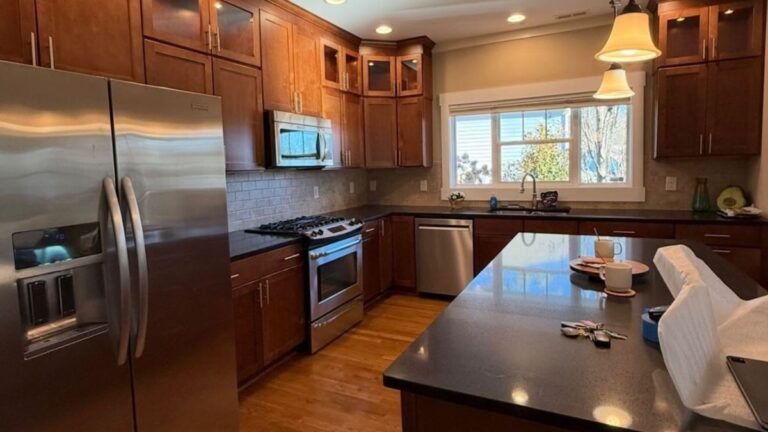


Dark wood ran across almost every cabinet surface in this kitchen, from the island to the tall uppers around the refrigerator and window. Black countertops, stainless steel appliances, wood flooring, and the cabinet layout were already in place, leaving the brown finish as the element with the most visual weight.

Raleigh-area cabinet refinishing team @myrenewedcabinets kept those cabinets and changed their finish instead. The doors, drawer fronts, frames, end panels, island, and crown molding were prepared for spray paint rather than removed for a new kitchen installation.
White paint changes the balance of the room without changing the cabinets themselves. Shaker-style doors, crown molding, and glass-front uppers stay in place, while black knobs and cup pulls connect the new finish to the existing dark counters.
Brown Cabinets Surrounded the Window and Work Zone

Cabinetry extends from the dishwasher past the sink and up beside the window, with another tall unit reaching the ceiling. Painting changes this entire wall without moving the sink, dishwasher, countertop, or window.
The Cabinet Doors Were Staying

Closer to the sink, the existing Shaker-style doors and drawer fronts are easier to see. Their proportions already fit the kitchen, and the cabinets extend around the window without leaving gaps that called for a new layout.
Replacing them would have meant removing cabinetry that still worked. The project instead focused on changing the finish, keeping the doors, drawers, counters, appliances, and wood floor in place.
Spray Painting Starts With Covering Everything Else

Spraying cabinets requires more than taking off the doors. Counters, floors, appliances, walls, openings, and cabinet interiors are masked so paint reaches the exposed frames without coating the kitchen around them.
Blue tape traces the cabinet edges while paper and plastic isolate the work area. That prep allows the boxes to receive the same finish as the detached doors and drawer fronts.
White Paint Reverses the Dark Cabinet and Counter Combination

Once painted, the cabinet color flips while the dark countertops stay. Black cup pulls and knobs replace the long silver hardware, repeating the counter color across the white fronts.
Glass-front uppers also remain part of the design. Their frames turn white with the rest of the cabinetry, so replacing the cabinets was not needed to get a different look.
Existing Cabinet Details Become Easier to See

Shaker-style profiles stand out against the new finish, while black cup pulls mark the drawers and round knobs sit on the doors. None of those door proportions needed to change for the cabinetry to read differently.
Black Counters Now Frame the White Cabinets

Dark countertops once continued the weight of the brown cabinetry. Against white, the same surfaces create a defined line around the perimeter and across the island.
Wood flooring stays untouched, preserving the warm material that was already in the room.
Paint Reaches the Cabinets From Floor to Ceiling

Tall uppers, corner cabinets, crown molding, base cabinets, and island panels now share one finish. Keeping the existing boxes also preserves the storage configuration that already fit the room.
The Before and After Doesn’t Look Like the Same Cabinetry

Placed side by side, the brown stain almost makes the original cabinets read as a different kitchen. White paint brings out the Shaker-style frames that were harder to notice against the dark wood, while black cup pulls and knobs connect the cabinets to the existing counters.
No new cabinet configuration was needed to get there. Spray painting changed the surface people see across almost every wall, which is why the finished kitchen reads as more than a cabinet color swap.
Would you spray dark wood cabinets like these, or keep the original stain?
Image credits go to @myrenewedcabinets