

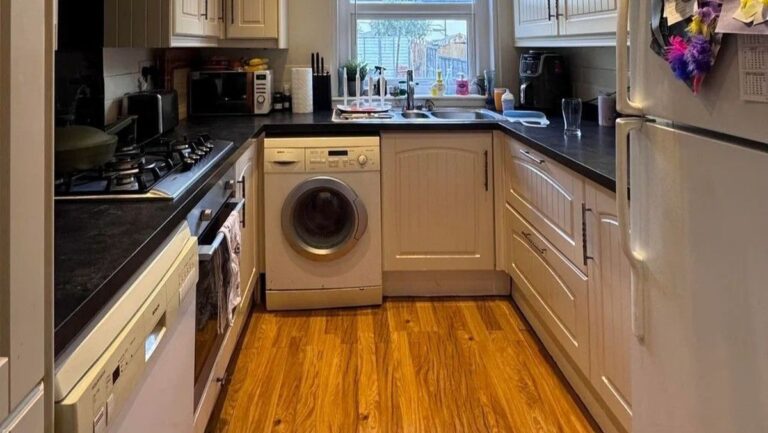


Many kitchen renovations begin with expensive custom cabinetry. This one began with plywood. After custom kitchen quotes came in far beyond budget, Reddit user u/j_fisher85 rebuilt a dated galley kitchen with simple materials and a clear Scandinavian-inspired design instead of settling for a standard remodel.

Rather than replacing the entire kitchen with new cabinet boxes, he reused existing carcasses where possible, built custom plywood fronts, relocated the sink beneath the window, installed made-to-order countertops, and finished the space with olive wall tiles, terracotta floor tiles, and exposed plywood edges.
Trial and error became part of the process, from recutting cabinet doors to laying the floor twice, yet the finished kitchen looks closer to a custom architectural project than a first-time DIY.
Existing Galley Layout Provided the Starting Point

The original kitchen followed a layout common in many UK homes. Cream raised-panel cabinets, black laminate countertops, upper cabinets across both walls, a washing machine beside the sink, and wood-look laminate flooring filled almost every surface.
Storage never presented a problem, but visual weight did. Cabinets surrounded the room from floor to ceiling, appliances remained exposed, and decorative moldings added another layer across the narrow galley.
Scandinavian Design Replaced Traditional Cabinetry

Flat plywood cabinet fronts replaced raised-panel doors and immediately changed the character of the kitchen.
Rather than covering the plywood layers with edge banding, the stacked wood grain remains visible across cabinet doors, drawer fronts, and countertops. Those exposed edges create thin horizontal lines that define the cabinetry without added trim.
Exposed Plywood Edges Became a Signature Detail

Exposed plywood edges became one of the kitchen’s defining design features.
Countertop edges, cabinet corners, and door fronts all reveal the laminated construction. Keeping those layers visible reinforces the workshop-built aesthetic while adding texture without introducing another material.
Olive Wall Tiles Replaced a Traditional Backsplash

Square olive tiles wrap the walls behind the counters and continue around each corner of the room.
Their muted earthy tone pairs with the pale plywood cabinetry rather than competing with it. The simple grid pattern introduces rhythm while allowing the wood grain to remain the dominant finish.
Farmhouse Sink Changed More Than the Cabinet Layout

Relocating the sink beneath the window reshaped one of the busiest areas in the kitchen while reinforcing the new Scandinavian direction. The oversized white farmhouse sink projects beyond the plywood cabinetry and immediately becomes the strongest focal point along the back wall.
Matte black fixtures strengthen that composition. The faucet, window frame, light switches, and outlets repeat the same finish across the room, creating sharp contrast against the pale plywood, white countertop, and olive tile. Together, those details give the restrained material palette a custom-built appearance.
Upper Cabinets Gave Way to Open Wall Space

Removing several upper cabinets changed the proportions of the galley more than any finish.
Large uninterrupted wall surfaces now extend above the backsplash, making the ceiling appear higher and the room wider. Existing upper cabinets remain along one wall, but their reduced presence creates far more breathing room than the original design.
Matching Plywood Handles Blend Into the Doors

Cabinet handles continue the same plywood detailing found throughout the kitchen.
Small plywood pulls project from each drawer and cabinet front instead of introducing metal hardware. Their shape remains simple while the exposed laminated layers echo every visible countertop edge throughout the room.
Terracotta Floor Tiles Shifted the Entire Color Balance

Wood-look laminate flooring disappeared in favor of square terracotta tiles.
The rich earthy surface grounds the lighter cabinetry while connecting with the olive backsplash above. White grout creates a regular grid that reinforces the clean geometric layout of the kitchen.
Plywood Details Replaced Decorative Hardware

Even the smallest details follow the same design language. Cabinet handles, exposed plywood edges, and flush panel joints repeat throughout the kitchen, creating consistency from one end of the galley to the other.
Black switches provide one of the few contrasting accents against the pale wood, while the matching plywood pulls blend into each drawer front. Repeating the same material throughout the cabinetry gives the kitchen the appearance of a custom-built installation rather than assembled flat-pack units.
Every Change Worked Toward the Same Design Goal

The galley layout changed very little, yet almost every visible surface was rebuilt. Traditional raised-panel cabinets, laminate flooring, dark countertops, and a washing machine beside the sink gave way to flat plywood cabinetry, terracotta floor tile, olive wall tile, a farmhouse sink, and integrated appliances.
Every change supports the same design direction. Reused cabinet carcasses, custom plywood fronts, open wall space, and a restrained palette transformed a dated galley kitchen into a Scandinavian-inspired space built almost entirely through DIY.
All image credit goes to reddit user u/j_fisher85.