



White oak dominates this kitchen from SCS Cabinets (@scscabinets), covering almost every cabinet from the floor to the ceiling. One large feature breaks from all that warm wood: a charcoal island topped in white stone.

The charcoal does not end at the island. Across the room, the range hood repeats the same dark finish, creating a second focal point within rows of inside-beaded Shaker cabinets. The two charcoal features face each other, with white oak filling the space around them.
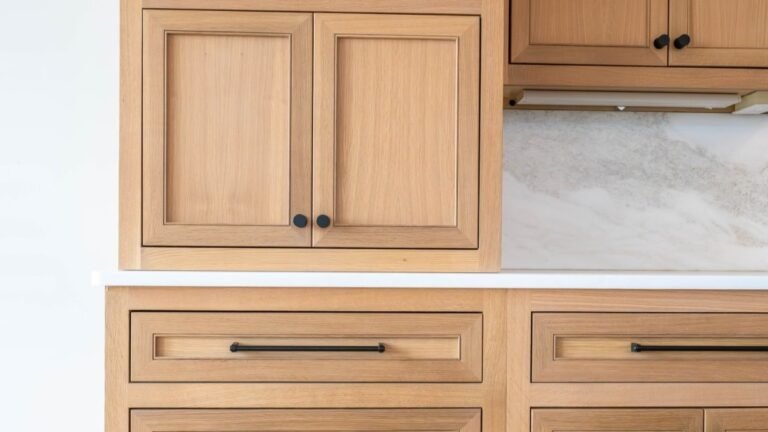
Matte black knobs and pulls carry the darker palette onto the oak cabinetry at a smaller scale. White counters and backsplash separate the wood and charcoal, while glass mullion doors and a concealed appliance garage add more detail without introducing another cabinet finish.
Charcoal Starts at the Island

White oak wraps around the kitchen, but the island abandons the wood finish for charcoal cabinetry. A white stone top keeps the dark base from becoming one solid block through the center of the room.
Black pulls on the oak cabinets introduce the same dark note around the perimeter. Glass mullion doors near the refrigerator provide another break from rows of solid wood fronts.
Range Hood Repeats the Island Color

Charcoal appears again above the range, where a broad hood sits between banks of white oak cabinets. Matching the hood to the island gives the dark finish a second destination rather than leaving one contrasting block in the center of the kitchen.
The hood also interrupts a long cooking wall dominated by oak. Pale backsplash tile and a white counter separate the charcoal hood from the lower cabinets, keeping each material distinct.
Island and Hood Line Up Across the Room

Seen from the end of the island, the connection becomes clear. The charcoal island points toward a hood finished in the same dark tone, with white oak filling the space around both.
That repetition changes how the contrast reads. Instead of an isolated dark island, the kitchen has two charcoal anchors on opposite parts of the plan.
Inside-Beaded Doors Add Detail to the Oak

The white oak doors use an inside-beaded Shaker profile, adding a narrow line inside each frame. Oak grain remains visible across the rails, stiles, and recessed center panels.
Matte black knobs stand out against the pale wood without covering much of it. Their small scale lets the grain remain the main feature while carrying the dark palette onto each cabinet door.
Black Hardware Runs Through the Cabinetry

Knobs appear on the upper doors, while longer black pulls mark drawers and lower cabinets. The hardware gives the white oak cabinetry repeated dark points from top to bottom.
Those details connect with the charcoal elements without requiring another painted cabinet section. Even the paneled cabinet ends retain the oak finish, so the black hardware does the smaller-scale work.
Hood Becomes More Than a Vent Cover

From the side, the hood reads as a large charcoal form set into the white oak cabinetry rather than an appliance meant to disappear. Its deep profile and crown detail give it enough presence to balance the island.
A black pot filler beneath it extends the dark accents onto the backsplash. Cabinet knobs, pulls, pot filler, hood, and island now repeat the same end of the palette at different scales.
Counter-Height Cabinets Conceal Another Feature

Not every cabinet is devoted to shelves. One pair of white oak doors comes down to the countertop, allowing the cabinet front to hide what would otherwise occupy part of the work surface.
Closed doors preserve the same inside-beaded profile and black hardware used throughout the surrounding cabinetry. Nothing on the exterior signals the counter space behind them.
Appliance Garage Keeps an Outlet Behind the Doors

Opening those doors reveals a counter-level appliance garage with an outlet at the back. Small countertop equipment can stay inside with access to power, then disappear behind the oak doors when not needed.
The detail fits the rest of the kitchen’s approach: large charcoal features create contrast, matte black hardware carries it across the cabinets, and white oak remains the dominant finish.
Which detail caught your eye first: the charcoal hood, the island, or all those small black accents?
Image credits go to Instagram @scscabinets.