

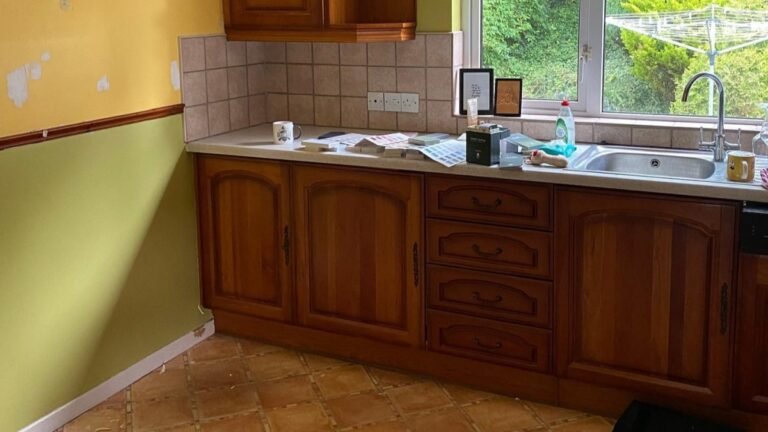

Orange-toned wood covered almost every cabinet front in this kitchen, from the units beneath the window to the tall bank surrounding the double oven. Raised-panel doors, dark decorative handles, and matching crown molding added even more warm wood across the room.

Painter Mariusz Plesner updated the existing cabinetry with a color matched to Farrow & Ball Vert De Terre. Rather than changing the cabinet doors or layout, the project used paint and new hardware to shift how the existing kitchen reads.
Muted green now covers the doors, drawer fronts, frames, molding, and open corner shelves. Existing countertops, tiled backsplash, black appliances, and terracotta-toned floor remain, making the effect of the cabinet color easy to see.
Orange wood ran across the original cabinetry

Warm wood surrounded the sink and continued around the corner toward the cooktop. Matching crown molding connected the upper cabinets across the window wall.
Dark traditional hardware reinforced the original look. Even the open corner shelves shared the same wood finish, leaving few breaks in the warm tone.
Raised-panel doors were kept

Paint did not hide the shape of the cabinet fronts. Curved raised panels, molded edges, drawer profiles, and crown details remain part of the kitchen after the color change.
Keeping those details gives Vert De Terre more dimension than it would have across flat slab doors. Recesses and projecting edges create subtle changes in the green as light moves across the cabinetry.
Vert De Terre replaced the orange-brown finish

Color matched to Farrow & Ball Vert De Terre covers the former wood finish from the base cabinets to the crown molding. The muted green sits between the warm floor and pale countertop without repeating either color.
Black ovens stayed in their original position, creating a dark break within the new green cabinetry. Existing beige and pink-toned backsplash tile also remained.
Green continues around the window wall

Cabinets beneath the large window received the same finish, carrying the new color around the L-shaped layout. Open shelves at each end were painted to match rather than left in their former wood tone.
Existing counters and sink stayed in place, so the biggest visual change comes from removing the orange finish that once surrounded them.
New hardware changes the cabinet fronts

Dark decorative handles disappeared during the update. Round metal knobs now sit on the doors, while cup pulls mark the drawers.

Their simpler shapes stand apart from the curved detailing on the cabinet fronts. Close up, the original door profiles remain clear beneath the new finish.
Existing tile became part of a different palette

Square backsplash tile was not removed when the cabinets changed color. Its warm beige and pink tones now sit between muted green cabinets rather than orange-brown wood.
Black cooktop and ovens provide contrast, while the pale worktop creates a lighter band between the green base cabinets and tiled wall.
Same kitchen, different dominant color

Side-by-side views show how much of the room stayed recognizable. Cabinet positions, window, counters, backsplash, floor, sink, and appliances remain in place.
What disappears is the large expanse of orange-toned wood. Vert De Terre shifts the cabinets toward a muted green while preserving the raised doors and molding that were already there, showing how a new cabinet finish can change the room without requiring a new kitchen.
Image credits go to Instagram creator @mariusz_plesner.