

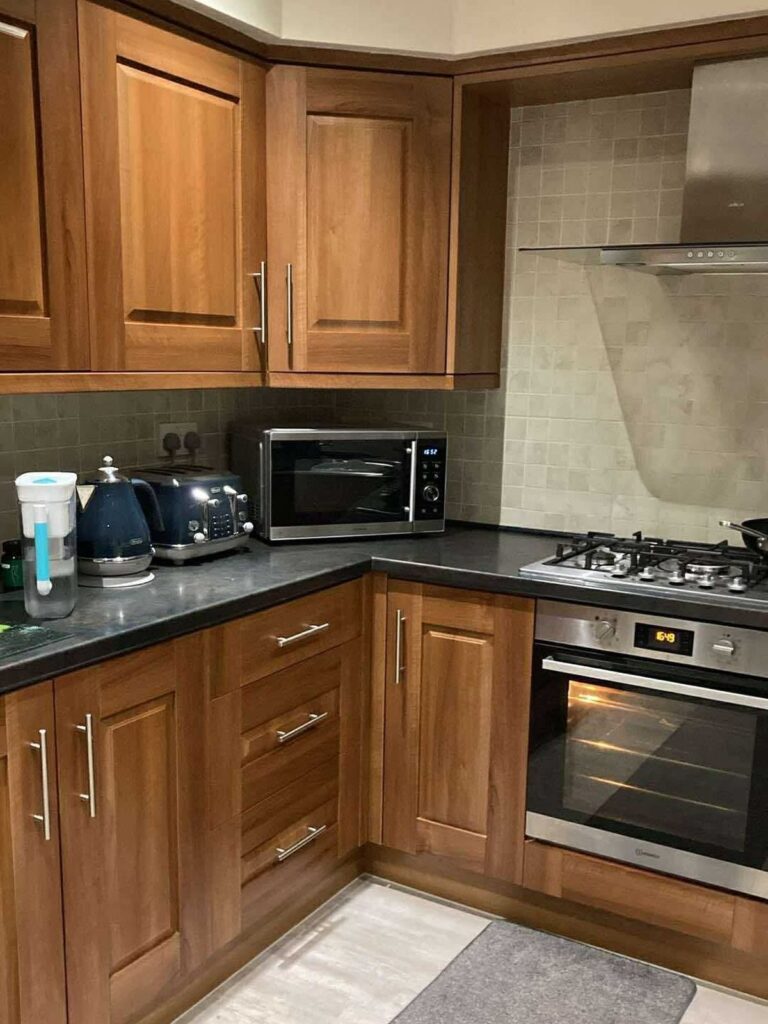


Wood cabinets covered three sides of this kitchen, paired with dark worktops, beige square tile, and silver handles. Instead of removing the fitted cabinetry, the doors were taken off and prepared for a spray finish as part of a makeover shared by Instagram creator @themobilespray.

Farrow & Ball Hague Blue now covers the same raised-panel cabinets in a matte finish, while pale worktops replace the dark surfaces around them. The cabinet configuration remains in place, including the tall appliance unit, corner storage, cabinets surrounding the cooktop, and sink run beneath the window.
Wood Cabinets Covered Three Sides of the Kitchen

Raised-panel wood cabinets filled the wall beside the refrigerator, continued around the corner, and framed the cooking area. Matching base cabinets extended toward the sink, creating a U-shaped arrangement with storage across almost every available section of wall.
Dark worktops sat above the wood base cabinets, while beige square tile covered the backsplash and the larger section behind the cooktop. Stainless appliances and long silver handles introduced metal finishes across the brown cabinetry.
Dark Worktops Ran Around the Existing Cabinet Layout

The cooking area shows how much of the original kitchen was already fitted around permanent elements. Base cabinets flank the oven, upper cabinets sit beside the hood, and a narrow corner cabinet connects the cooktop wall with the longer worktop run.
Rather than rebuilding those sections, the project kept the doors, drawers, cabinet boxes, appliances, and backsplash in their existing positions. That made the wood finish and dark worktops two of the largest surfaces targeted for change.
Cabinetry Framed the Cooktop and Oven

Viewed from the entrance, the original cabinetry creates a compact U around the work zone. The oven sits beneath the gas cooktop, the stainless hood occupies the center of the tiled wall, and cabinets fill the spaces on both sides.
That arrangement remains visible in the finished kitchen. The makeover changes how the fitted pieces read without moving the cooktop, oven, hood, or sink to new positions.
Cabinet Boxes Were Masked Before Spraying

Plastic covered the cabinet openings after the doors and drawer fronts were removed. Worktops, appliances, backsplash sections, walls, and flooring were also masked to protect the surrounding kitchen while the fixed cabinet sections were prepared.
The tall cabinet beside the refrigerator stayed in place, along with the frames beneath the worktop and around the upper cabinets. Those fixed pieces needed the same new finish as the detached doors so the completed cabinetry would read as one surface.
Masking Extended Across the Cooktop Wall

Protection continued around the cooktop, oven, sink run, and upper cabinets. Plastic covered the appliances and open cabinet interiors, while paper and tape isolated the floor and work surfaces from the spray area.
The beige square backsplash was retained, including the larger tiled section behind the hood. Keeping it becomes important once Hague Blue is introduced because the pale tile forms a much stronger contrast with the new cabinet color than it did with the brown wood.
Sanding Cut Through the Finish on the Wood Doors

Removed cabinet doors were arranged on stands for preparation away from the kitchen. The creator describes the process as sanding, degreasing, and priming before another sanding stage and the final color coats.
The prepared doors show how the original raised-panel profiles were retained. Rails, stiles, recessed centers, and edges remained intact, allowing the project to change the finish without replacing the fronts.
Hague Blue Covered the Existing Raised-Panel Doors

Farrow & Ball Hague Blue was applied in two top coats with a matte finish, according to @themobilespray. The deep blue covers the wood grain and connects doors that had shown variations in tone across the original kitchen.
Spraying also carries the color into the recessed sections and narrow edges of each raised-panel door. Once the fronts return to the cabinet boxes, those profiles remain visible without the brown wood competing with them.
Pale Worktops Changed the Contrast Around Hague Blue

Reassembled cabinetry shows Hague Blue across the tall storage, upper cabinets, drawers, base cabinets, plinths, and fixed side panels. The existing silver bar handles return against the blue rather than being replaced with another hardware style.
Pale worktops now sit above the base cabinets, removing the dark band that once ran around the kitchen. Beige backsplash tile remains between the two finishes, creating a transition from the deep cabinet color to the light work surface.
Existing Appliances Stayed Inside the New Color Scheme

Stainless appliances occupy the same positions after the cabinet respray. The oven remains beneath the gas cooktop, the hood stays centered on the tiled wall, and the sink remains beneath the window.
Hague Blue now frames those metal surfaces from both sides. Keeping the appliance positions makes the scale of the finish change clear because the kitchen’s main working arrangement has not been rebuilt around a different layout.
Sink Run Became Part of the Hague Blue Cabinetry

Blue base cabinets continue around the corner toward the stainless sink, carrying one cabinet color across the full U-shaped layout. The pale worktop follows the same route and ends above the blue side panel at the edge of the sink run.
The beige tile, stainless sink, chrome faucet, oven, cooktop, and hood remain recognizable from the original kitchen. Most of the visual shift comes from changing the large wood and dark worktop surfaces surrounding those retained elements.
Raised-Panel Profiles Remained Visible Under the Paint

A closer view of the upper cabinets shows the original door construction beneath the matte Hague Blue finish. Recessed centers and framed edges remain defined, while the former wood grain no longer separates one door visually from the next.
Silver bar handles were also retained, giving another direct reference to the original cabinetry. Against Hague Blue, the same hardware creates a sharper contrast without requiring another change to the doors.
Hague Blue Connects the Cooktop and Sink Runs

From the cooking area, Hague Blue extends from the base cabinets beside the oven around the corner to the sink. Upper cabinetry uses the same finish, while the pale worktop creates a continuous light surface between the dark blue fronts and beige backsplash.
The combination changes the balance of the room without covering every original finish. Beige tile and stainless appliances remain, so the cabinet color becomes the dominant new element rather than part of a complete kitchen replacement.
Cabinet Color Changed More Than the Layout

Another view across the corner shows drawers, doors, worktop positions, and appliances occupying the same sections of the room. Hague Blue changes how those existing pieces connect, turning separate areas of brown cabinetry into one continuous dark blue run.
The pale worktops also expose the shape of the U more clearly than the previous dark surfaces. Their lighter color creates a defined horizontal line around the work area while the cabinets form the darker section below.
Wood Cabinetry Became Hague Blue Without Replacing the Doors

Side-by-side views make the retained layout easy to identify. The oven, cooktop, hood, sink position, tiled backsplash, and cabinet arrangement appear in both versions, while brown wood on one side becomes Hague Blue on the other.
Dark worktops give way to pale surfaces, while a glass splashback was added behind the cooktop beneath the existing stainless-steel hood. With the existing doors returned to their original positions, the Hague Blue finish and new worktops account for much of the change without requiring a new set of cabinet fronts.
All credits go to Instagram creator @themobilespray