


Cabinet handles may take up little space, but their proportions can change how a cabinet front reads. Some stretch across much of a wide drawer, while others run down tall doors or sit as compact grips against larger panels.

Extra-long pulls stand out most on flat cabinetry, where few other details interrupt the surface. Their horizontal or vertical lines become part of the cabinet design rather than hardware that fades into the background.
The examples below show how handle length, shape, and placement can produce a different effect even before cabinet color or material enters the equation.
Long pulls stretch across wide drawers

Stainless steel pulls run across much of the wide drawer fronts beside the range, creating strong horizontal lines against the warm wood cabinetry. Their length follows the proportions of the drawers instead of concentrating the hardware near the center.
Matching metal on the range ties those lines to the appliance, while the dark countertop creates another horizontal band above them. Shorter pulls would expose more wood, but these become part of the cabinet design.
Tall cabinet doors get long vertical handles

Two slim metal handles extend down much of these tall wood doors, turning the hardware into a vertical detail rather than a small grip near the center.
Their narrow profile keeps the wood visible between and around them, while the length follows the scale of the doors. Instead of breaking the tall fronts into smaller sections, the handles reinforce their height.
Chunky pulls add contrast to flat cabinet fronts

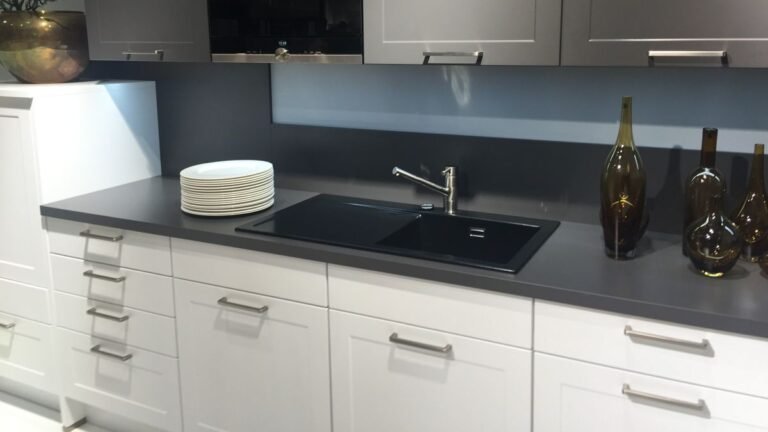
Dark lower cabinets use short rectangular pulls with broad ends, while the upper cabinets have no visible hardware from this angle. The compact handles create small metal accents across the base cabinets without spanning each door.
Their squared shape also fits the straight edges of the doors, countertop, and sink. Against the muted cabinet finish, each handle reads as a distinct piece rather than disappearing into the front.
Small brass pulls stand out against green cabinets

Green paneled cabinetry surrounds two red ovens, with small brass-toned pulls positioned near the lower corners of the tall cabinet doors. Their warm finish stands apart from the green paint without competing with the large appliances.
Size makes a difference here. Large bar pulls would add another strong element beside the red ovens, while these smaller handles leave the cabinet panels as the dominant feature.
Cup pulls and knobs suit different cabinet fronts

Dark base cabinetry in this kitchen uses metal cup pulls across the drawers, where the curved hardware creates a horizontal grip. Cabinet doors below use smaller knobs instead of repeating the same shape.
White upper cabinets use knobs as well, keeping their tall recessed panels free from long metal bars. Hardware changes with the type of front, but the similar metal finish connects the separate pieces.
Long bar pulls repeat around the range

Wood drawers on both sides of the range carry long horizontal bar pulls, with each handle centered across its front. Repetition creates a series of parallel metal lines from one side of the cooking area to the other.
Stainless steel appliances occupy the center, so the pulls extend that metal finish onto the surrounding cabinetry without covering the wood grain.
Small hardware keeps paneled cabinets in focus

White paneled cabinets use restrained knobs and pulls rather than oversized hardware. Tall door panels remain uninterrupted across most of their surface, allowing the recessed detailing to stay visible.
Lower gray cabinetry uses cup pulls on the drawers and smaller hardware on the doors. Here, the handles sit within a kitchen already filled with panel lines, backsplash boards, and countertop edges, so their compact size keeps them from adding another dominant pattern.
Extra-long pulls become part of the drawer fronts

Long metal pulls stretch across much of these dark drawer fronts, with several sizes used to follow the width of the cabinetry beneath the cooktop. Instead of reading as small pieces attached after the cabinets were designed, the handles form horizontal bands across the entire island.
Dark textured fronts make the brushed metal easy to see, while the repeated placement lines up from one drawer stack to the next. Hardware becomes one of the most visible details on an otherwise flat run of cabinetry.
Wide handles stand out against glossy red cabinets

Glossy red drawer fronts use wide metal handles with angled ends, creating dark reflections and strong horizontal lines across the bright cabinetry. Wider drawers receive longer pulls, so the hardware stays in proportion with the surface behind it.
Chrome against red makes the handles hard to miss, especially with few other details breaking up the flat fronts. Here, changing the hardware to small knobs or short pulls would change much of what you see across the cabinet run.