

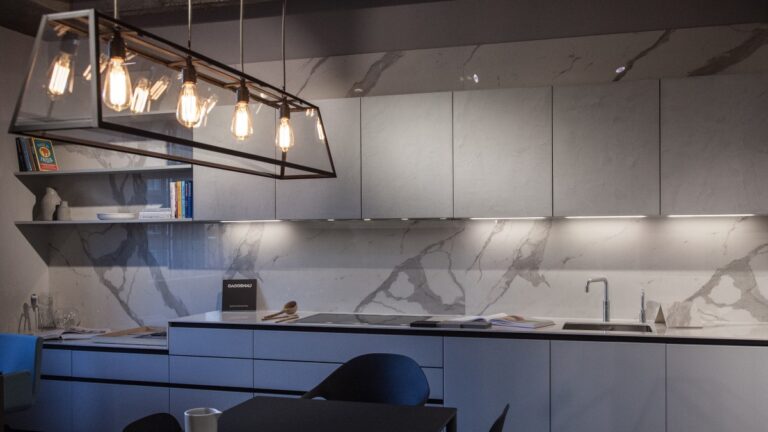


White kitchens have spent years taking criticism for looking cold, blank, or too close to a showroom. White cabinets paired with white counters can create that problem, but removing white from the kitchen is not the only answer.

Here, pale slab cabinets cover most of the room, yet the kitchen has none of the all-white formula that gave the look its sterile reputation. Dark oak flooring, a black dining table, black chairs, exposed concrete, marble veining, and a steel-framed pendant give the white surfaces something to work against. White remains the main finish, but contrast controls how the room reads.
White Cabinets Cover the Wall Without Making It Feel Blank

Cabinet fronts run from the base units to the tall appliance wall, with upper cabinets reaching toward the exposed ceiling. Flat doors remove knobs, rails, and trim, so the white cabinetry reads as broad blocks rather than a collection of separate cupboards.
Black lines keep those blocks from merging into one pale surface. Dark recessed pulls cut across the lower cabinets, built-in ovens interrupt the tall units, and dark flooring creates a firm boundary beneath the cabinetry. White dominates the wall without dominating the room.
Marble Veining Breaks Up the Long White Run

Stone across the backsplash changes what could have been the most sterile part of the kitchen. Gray veins cross the white surface behind the sink and continue above the upper cabinets, creating movement across a wall built from straight cabinet lines.
Exposed concrete above adds another gray surface, but with a raw texture instead of a polished finish. Black chairs and the dining table sit in front, so pale cabinets become the background rather than the feature demanding all the attention.
Open Shelves Keep One End From Becoming Another Cabinet Block

Open shelves replace upper cabinets at the left end of the kitchen, exposing books, dishes, glassware, and small objects against the stone wall. That break matters in a kitchen where most storage sits behind flat doors.
Stone also runs behind the shelves and across the backsplash, connecting the open section with the closed cabinetry. Instead of adding another color, the design changes depth and storage type to stop the wall from becoming repetitive.
Black Details Give White Cabinets an Edge

Drawer storage shows how much contrast comes from details that occupy little space. White fronts surround a dark interior fitted with black cutlery dividers, while brass-toned flatware adds a small metal accent inside the drawer.
Induction cooktop above brings another black plane into the counter. None of these elements compete with the cabinetry, but together they stop white from becoming the only surface the eye registers.
White kitchens do not need more white to look cohesive, nor do they need color on every cabinet to avoid feeling sterile. Strong dark surfaces, visible stone pattern, open storage, metal, and material changes can give pale cabinetry enough contrast to hold its place without turning the whole room into a white box.
Would you keep the white cabinets in this kitchen, or would you bring color into the cabinetry too?