



Most people assume choosing a countertop starts with picking a color. Walk into a showroom, though, and the first decision isn’t white, black, gray, or beige. It’s the material itself.

Countertops are grouped into natural stone, quartz, ceramic, glass, laminate, compact laminate, and solid surface because each one performs differently. Durability, maintenance, fabrication, and installation all change with the material, making color the second decision instead of the first.
The Material Categories Come Before the Color

Countertop displays now separate products into natural stone, quartz, solid surface, ceramic, glass, laminate, and compact laminate instead of mixing every finish together. Each section represents a different construction method rather than a different shade.
This layout helps homeowners compare how each material performs before narrowing the selection to patterns and colors. Two countertops may look similar from a distance while behaving very differently after years of daily use.
Natural Stone Offers Patterns That Cannot Be Repeated

Natural stone remains the only category where every slab develops its own mineral pattern. Granite and other stones contain natural movement, crystals, and color variations that cannot be manufactured into identical copies.
The display shows why natural stone continues to attract homeowners looking for unique surfaces instead of factory-produced consistency. Each slab becomes part of the final kitchen design.
Ceramic and Glass Are Displayed as Separate Material Families

The showroom separates glass and ceramic into two independent collections instead of treating them as color variations. The glass samples appear in solid translucent colors, while the ceramic collection focuses on matte finishes that imitate stone, concrete, and other mineral surfaces.
The display makes the decision straightforward. Homeowners choosing glass prioritize color and reflectivity, while ceramic appeals to those looking for a hard surface with stone-inspired finishes and large-format slabs.
Laminate and Compact Panels Look Similar but Serve Different Purposes

Laminate and compact panels occupy separate sections even though several samples share similar wood and stone patterns. The distinction comes from the construction rather than the printed finish.
Standard laminate remains a budget-friendly surface applied over a substrate, while compact panels are manufactured as dense structural boards that create thinner countertop profiles and exposed edges without additional finishing. The display encourages homeowners to compare the material itself before choosing a pattern.
Stone Looks Extend Beyond Natural Stone

This gray surface recreates layered mineral textures with subtle variation that continues across the countertop. The undermount stainless sink sits flush beneath the slab, allowing the pattern to remain the focal point.
Instead of relying on heavy speckling or dramatic contrast, this finish delivers the look of weathered stone with a controlled pattern that works across large islands and long work surfaces.
Black Stone Makes White Veins Stand Out

Thin white veins stretch across a deep black countertop, creating contrast without overwhelming the surface. The pattern remains open enough that the island still reads as one uninterrupted slab.
Large islands allow this style to make the strongest impact because the veining can travel across the entire countertop instead of breaking into smaller sections.
Glass Introduces Color That Stone Cannot

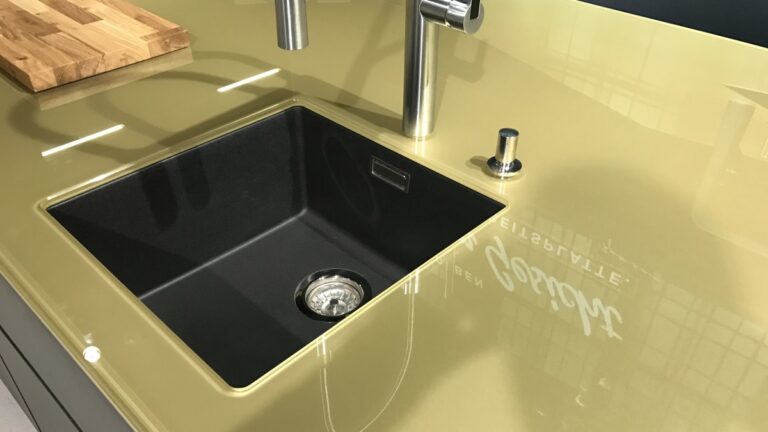
This glass countertop replaces stone textures with a smooth, translucent surface that brings muted olive green into the kitchen. The glossy finish reflects surrounding light while creating a seamless work surface around the sink and cooktop.
Unlike natural stone, glass can introduce solid colors without veining or mineral patterns. That makes it a distinct option for contemporary kitchens where the countertop becomes part of the overall color palette rather than an imitation of another material.
Matching Materials Create Continuous Surfaces

The countertop continues directly into the backsplash using the same material, color, and finish. Without tile joints or contrasting surfaces, the sink wall reads as one uninterrupted plane from the work surface to the upper edge of the backsplash.
Using the same material across both surfaces creates a cleaner appearance while reducing visual breaks around the sink. Large-format slabs have made this approach much more common in contemporary kitchens, where continuity often takes priority over decorative contrast.
Granite Shows Natural Mineral Pattern

The granite slab combines black, gray, and white mineral crystals that create texture across the entire island. Unlike surfaces with printed veining, the pattern comes from the stone itself, giving the countertop a more granular appearance.
Granite remains a popular choice for homeowners who prefer natural variation over uniform finishes. Its dense mineral pattern works well in kitchens where the countertop is intended to become a defining design feature.