



You stand in the showroom with two samples in your hands. The speckled granite looks like every kitchen built in 1998. The white quartz looks clean, safe and a little flat. The salesperson says quartz is what everyone wants, and until recently, designers agreed.
They don’t anymore. In the National Kitchen & Bath Association’s 2027 Kitchen Trends Report, designers named quartzite and quartz as their two favorite countertop materials: 78% for quartzite, 74% for quartz. A year earlier, quartzite sat at 62%, still behind quartz. The survey drew 830 responses from kitchen professionals across the U.S. and Canada, and 62% of them were designers. A natural stone has moved to the front of the line.
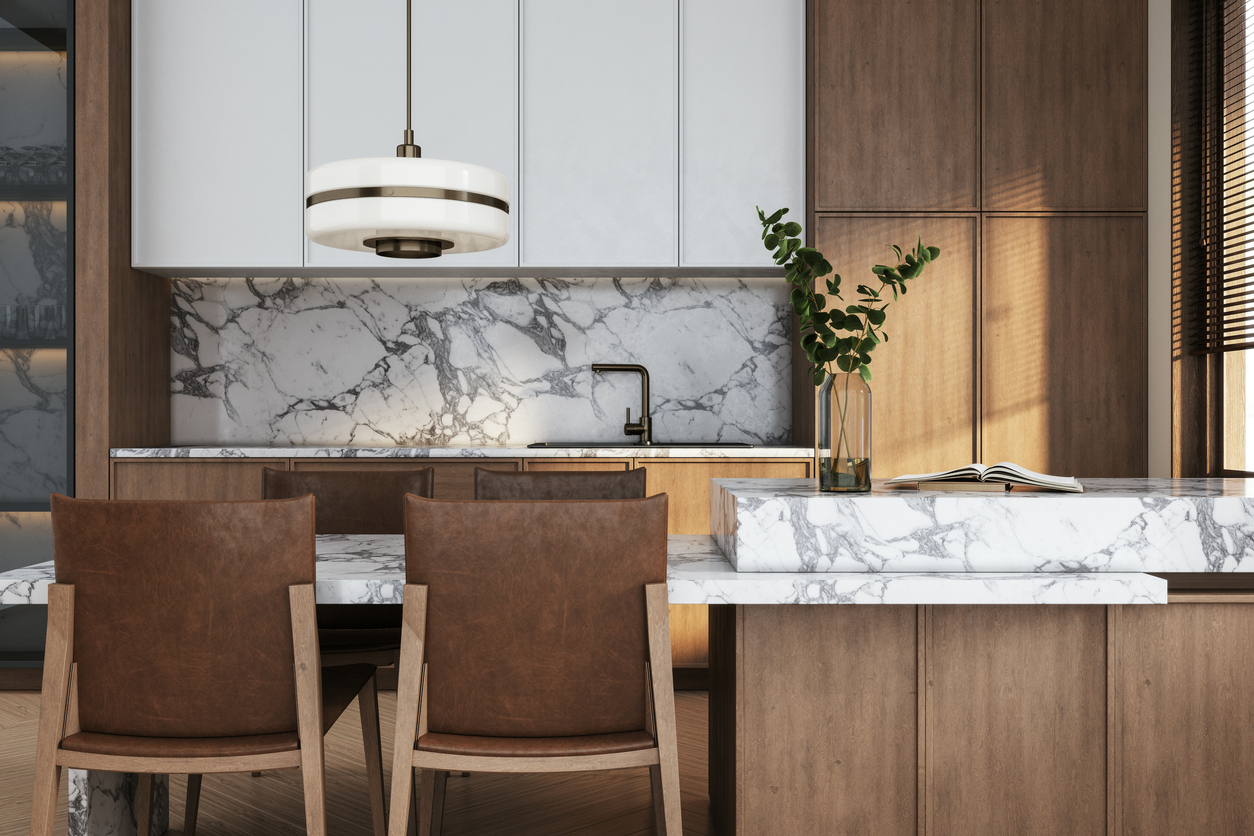
Why designers are trading engineered stone for the real thing
Quartz and quartzite are not the same product. Quartz countertops are engineered: quartz aggregate combined with resins, then pressed into slabs. Quartzite is a natural rock, quarried and cut into slabs like granite, and some white varieties are easy to mistake for marble.
Because quartz relies on resin, one major quartz maker’s care guide asks owners to protect it from temperatures above 300°F and never to set hot pots and pans directly on the surface. Quartzite is solid stone, with no resin binder.
In the same report, 48% of designers said they prefer honed or matte finishes, 49% named white oak as their favorite wood and 34% expect natural, unfinished wood cabinets to be popular. Real stone sits naturally next to real wood.
The shift comes as engineered stone faces scrutiny. Federal researchers note these products can contain up to 93% crystalline silica, and cutting dust can cause silicosis in fabrication workers. California’s workplace safety standards board voted unanimously in May 2026 to start the process of banning the fabrication and installation of artificial stone with more than 1% crystalline silica.
How to make sure the slab is really quartzite
Here is the catch: not every slab sold as quartzite is quartzite. Some are marble or dolomite, which can etch when acid touches them. Ask for an offcut, or permission to test a corner of the slab, and run three checks:
- The glass test. Press a sharp edge of the sample into a glass tile and drag it firmly. Real quartzite leaves a scratch you can feel. Marble does not scratch glass.
- The knife test. Drag the tip of a pocketknife across the stone in a few spots. Quartzite won’t be scratched; marble will. A silvery line that wipes away is only metal from the blade, not a scratch.
- The lemon test. Leave several large drops of lemon juice or vinegar on the surface for 5 to 10 minutes, wipe them off and look at the spot from a low angle. A dull patch means the stone contains calcite or dolomite. Sealer won’t prevent this, so the test works on sealed slabs too.
If a seller describes a stone as “soft quartzite,” treat it as marble until it passes these tests. Super White, for example, is a dolomite, not a quartzite.
What quartzite still asks of a busy kitchen
Quartzite is harder than marble, but it is not maintenance-free. Unlike quartz, which needs no sealing, natural quartzite needs resealing every one to two years. Price is close to quartz: in a 2022 comparison, 30 square feet of installed quartzite averaged about $3,950, against about $3,750 for quartz.
Switching materials also doesn’t remove the dust problem for the people who cut the stone. California’s December 2023 emergency rule already covers high-exposure work on natural stone with more than 10% crystalline silica. Ask your fabricator how they control dust in the shop, and favor one who can explain it clearly. A CDC bulletin reports that 51% of inspected stone shops in California had at least one worker exposed above the legal limit.
Pick the slab with your eyes, then confirm it with a piece of glass and a lemon. That’s the trick.